
- Version
- Download 1622
- File Size 68.21 KB
- File Count 1
- Create Date October 1, 2013
- Last Updated October 12, 2026
Numbering Cheat Sheet
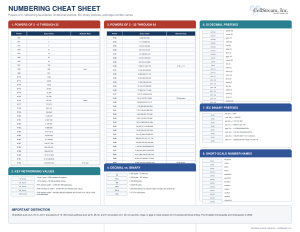 This updated Numbering Cheat Sheet is designed as a practical reference for anyone working with networking, computing, storage, data rates, or IPv4/IPv6 addressing. It brings together the powers of two that appear constantly in technical work, important networking bit boundaries, decimal SI prefixes, binary IEC prefixes, and common large-number names in one place.
The sheet is especially useful because networking mixes several numbering systems that are easy to confuse. Powers of two are fundamental to addressing and memory calculations, while network speeds and SI prefixes are normally expressed in powers of ten. The updated version makes that distinction explicit so you can quickly see, for example, that 1 kB = 1,000 bytes while 1 KiB = 1,024 bytes, or that 2^32 = 4,294,967,296 while 2^64 = 18,446,744,073,709,551,616. The original sheet already centered on these powers-of-two relationships, including IPv4 and IPv6 boundaries. Numbering Cheat Sheet
How to use the cheat sheet: start with the quantity or bit width you are working with, then look up the corresponding exact value. For networking, the highlighted boundaries are especially useful: 8 bits for an octet, 16 bits for an IPv6 hextet, 32 bits for an IPv4 address, 64 bits for an IPv6 Interface ID-sized field, and 128 bits for a complete IPv6 address. Use the SI and IEC sections when you need to distinguish decimal measurements such as Mbps or GB from binary quantities such as MiB or GiB.
The updated content also corrects and modernizes the large-number and prefix sections. It uses current SI prefixes such as ronna, quetta, ronto, and quecto, and it separates those from IEC binary prefixes such as kibi, mebi, gibi, and tebi. This is particularly helpful when reading equipment specifications, storage capacities, memory sizes, interface speeds, packet counters, or very large IPv6-related values.
Download it, print it, and keep it nearby for subnetting work, IPv4/IPv6 instruction, protocol analysis, storage and bandwidth calculations, certification study, or classroom labs. It is intended to save time, reduce mental arithmetic, and provide a reliable reference whenever those familiar powers of two and large technical numbers start running together.
Did you find this useful? Would you change or modify this file in any way? If you would like to help support the continued development of independent networking, broadband, Wi-Fi, VoIP, and packet analysis content, please consider joining our Patreon community where you will gain access to exclusive technical resources, downloadable labs and PCAPs, bonus course content, troubleshooting guides, and additional member-only material. You can also leave comments at our Discord server. You can also support our work by simply buying us a coffee — every contribution helps us continue creating practical, real-world network science education for professionals and enthusiasts alike.