

What we know as of November 17, 2026
A fine good morning to everyone. The investigation into the November 13 FAA nationwide ground stop continues to get more interesting.
In the first three articles in this series, I followed the story from the initial reports of a nationwide telecommunications failure through the identification of routers at El Dorado, Arkansas, and Amarillo, Texas, and finally into the still-unexplained “broadcasting function” associated with the new equipment.
If you are joining the story here, the earlier articles are:
Part 1 — Another FAA Outage: What We Know
Read Part 1
Part 2 — FAA Outage Follow-Up: What We Have Learned About the Network
This article looks at L3Harris, the FAA Telecommunications Infrastructure (FTI), and a conceptual reconstruction of the network architecture.
Read Part 2
Part 3 — FAA Outage Update: El Dorado, Amarillo and the Mysterious “Broadcasting Function”
This article examines the interaction between the two locations, the approximately 1,000 connection attempts every four to five seconds, and some possible network mechanisms worth investigating.
Read Part 3
Now we have several new pieces of information. And they move the investigation in an interesting direction: configuration and compatibility.
Let me be very clear at the outset. Neither configuration error nor incompatibility between Juniper and Cisco equipment has been established as the root cause. The investigation remains underway. But the information released over the last 24 hours gives us considerably more to work with.
HPE: The Router Worked “As Configured”
Perhaps the most important new statement has come from Hewlett Packard Enterprise, which owns Juniper Networks. HPE says that, based on the information available to it, the router involved in the incident was “working as configured.” In a more detailed statement reported by ABC News, HPE said the device:
“functioned as it was configured to by the installer.”
HPE further said that the device itself did not fail or act improperly. The FAA is now examining the configuration and performance of all of the infrastructure involved.
That is a very important distinction. Consider the difference between these two failure models:
Model A: Faulty router -> Router malfunctions -> Network fails
and:
Model B: Router operates according to configuration -> Configured behavior interacts unexpectedly with surrounding network -> Other equipment reacts -> Network instability propagates
If HPE’s assessment ultimately survives the investigation, the second model becomes much more interesting.
The question would no longer simply be: What was wrong with the router?
It becomes: Why did the router do something that it was apparently configured to do, and why was that behavior capable of destabilizing such a large portion of the FAA network?
We Now Know the Scale of the Juniper Deployment
Another important detail has emerged from information L3Harris provided to congressional offices. The FAA’s current telecommunications transition reportedly involves converting 3,648 routers to Juniper devices.
According to the information provided to senators: approximately 400 routers have been installed and 69 are currently operational.
That significantly changes the scale of the story. Until now, we have been discussing approximately 60 routers on which the FAA disabled the mysterious “broadcasting function.” We can now see that these routers are part of a much larger replacement program:
3,648 planned replacements -> ~400 installed -> 69 operational -> broadcast functionality disabled on currently affected/deployed population
There is a slight difference in the numbers being used publicly. The FAA says it disabled the same functionality on approximately 60 similar routers. Transportation Secretary Sean Duffy subsequently said there are 69 of these routers in the National Airspace System and their ability to broadcast has been stopped.
I would not read too much into the difference between 60 and 69 yet. It could reflect timing, the precise equipment population being counted, or simply the FAA using an approximate number in its original Q&A.
The significant point is that this feature was not limited to the El Dorado router. It existed across a deployed population of similar equipment.
Congress Is Now Asking the FAA to Pause the Deployment
On November 17, thirteen Democratic members of the Senate Commerce Committee asked the FAA to pause further deployment of the new Juniper routers until outstanding reliability questions are addressed.
Their requests include: operational testing, independent validation, verified failover capability, and rollback procedures before broader deployment continues.
That is particularly relevant from a network-engineering perspective. Those are exactly the kinds of controls that should limit the impact of a failed equipment deployment or configuration change. The question is no longer merely whether the individual router worked. It is also whether the deployment process and network architecture were capable of safely containing unexpected behavior.
A Juniper-to-Cisco Interaction?
This is where things become especially interesting — and where we need to be careful about what is confirmed.
CRN reported November 16 that a source with knowledge of the incident believes the broadcasting capability on the new Juniper equipment should have been disabled when communicating with the approximately 20-year-old Cisco equipment still operating in the FTI environment. The source told CRN that the capability should not have been enabled in such a large legacy environment.
That is not an official FAA finding. It is an anonymously sourced industry report. Therefore, I would not yet say: Juniper routers are incompatible with the old Cisco routers. We do not have evidence to support such a broad statement. But the report raises a very legitimate engineering question:
Was a feature enabled on the new Juniper equipment that should have been disabled, filtered or otherwise constrained when interfacing with the older Cisco-based FTI infrastructure?
That is very different from ordinary vendor “compatibility.” Juniper and Cisco routers obviously interoperate using standards-based protocols every day. The more precise question is whether a particular configured feature, service or behavior created an interaction that the surrounding legacy environment was not designed or configured to tolerate.
That is where I think the investigation is heading.
What Might “Compatibility” Really Mean?
When network engineers hear the word compatibility, it is tempting to imagine: Cisco speaks one language versus Juniper speaks another language.
That is probably too simplistic.
Both platforms support standards-based technologies such as Ethernet, IP, BGP, OSPF, TCP, UDP and multicast. A more realistic interoperability problem might involve:
- different default behaviors,
- different timer values,
- service-discovery behavior,
- protocol extensions,
- multicast behavior,
- handling of malformed or unexpected messages,
- session retry behavior,
- route advertisement or redistribution,
- management-plane functions,
- vendor-specific extensions,
- or simply an inappropriate configuration pushed onto otherwise interoperable equipment.
In other words: standards compatibility does not guarantee operational compatibility under every configuration.
That distinction matters.
As of this morning, I have not found a public statement from Cisco itself on the FAA outage. What we do know is that Cisco engineers are participating in the diagnostic work at the L3Harris lab in Florida, alongside FAA and Juniper engineers.
Let’s Revisit the “Broadcasting Function”
The FAA continues to use the word broadcasting. Transportation Secretary Duffy said that the El Dorado router was broadcasting data from the radio facility “into the whole network.” He further said:
“We have 69 of these routers in the national airspace. We’ve stopped their ability to broadcast.”
That statement gives us another useful clue. Whatever this function is, apparently:
- it exists on a population of the new routers,
- it can be disabled,
- disabling it does not prevent those routers from continuing to perform whatever essential function they provide,
- and the FAA believes disabling it prevents recurrence of the problem.
That strongly suggests we are looking at a specific configurable behavior, rather than an unavoidable fundamental property of IP networking. But we still do not know its actual Junos feature name. That remains one of the most frustrating gaps in the public explanation.
“Broadcast” Still May Not Mean Ethernet Broadcast
I want to repeat this because the terminology continues to create confusion. Nothing released by the FAA establishes that this was a traditional Ethernet broadcast storm. In Ethernet, a broadcast normally means a Layer-2 frame destined for: FF:FF:FF:FF:FF:FF and delivered throughout the local broadcast domain.
If that were truly what happened, I would have additional architectural questions because a Layer-2 broadcast domain associated with a remote FAA radio facility should not intuitively encompass most of a nationwide routed network.
The fact that Duffy describes one router as “broadcasting data” into the entire network makes me suspect that broadcasting is being used descriptively rather than as the precise Ethernet term.
We need the actual protocol.
The 1,000 “Connection Attempts” Remain a Critical Clue
The FAA continues to say that its equipment became unstable while experiencing approximately: 1,000 connection attempts every four to five seconds. That is approximately: 200–250 connection attempts per second.
As I discussed in Part 3, that number by itself is not particularly impressive if we are talking about ordinary forwarded packets. A modern router can process vastly more traffic than that. Even many older platforms can forward orders of magnitude more packets.
So once again: What is a connection attempt?
If each event required the router CPU to:
- create session state,
- authenticate something,
- establish a peer relationship,
- allocate memory,
- process a management message,
- update routing state,
- or perform some other software-driven operation,
then 250 events per second may be very different from 250 ordinary forwarded packets per second. That could also help explain why older equipment experienced more difficulty while newer equipment reportedly remained operational.
New Equipment Causing Problems for Old Equipment?
Secretary Duffy has increasingly emphasized that the newer equipment did not fail while older routers experienced the instability. CRN quotes him saying that newer routers already installed in the system did not go down when the network was flooded. If accurate, that gives us an intriguing conceptual model:
New Juniper router activated -> configured feature begins operating -> traffic/messages distributed into FTI -> other new equipment tolerates behavior -> older Cisco equipment experiences excessive processing condition -> communications/radar instability -> 17 of 22 ARTCCs affected
Again, this is not yet the established root cause. But it is now a useful model to test against whatever technical information comes next.
And Amarillo Still Matters
We should not lose sight of Amarillo. The El Dorado router was being activated on November 13. But Duffy says that when it came online, equipment at Amarillo that L3Harris had replaced approximately three weeks earlier also began flooding the network. That remains one of the strangest elements of the entire incident. Why would the activation of El Dorado change the behavior of Amarillo? If configuration and compatibility are becoming central questions, then I would particularly want to compare the two devices:
- same Juniper model?
- same Junos software release?
- same configuration template?
- same broadcasting feature enabled?
- same routing policy?
- same management controller?
- same service or peer group?
- same firmware image?
If both routers suddenly participated in the same pathological behavior, the common denominator may tell us more than examining El Dorado alone.
Could This Be a Configuration Template Problem?
Now we are getting into informed speculation, so I want to label it accordingly. One possibility I would investigate is a configuration-template problem. Large router deployments are rarely configured manually one device at a time. They commonly use standardized templates. Suppose a feature was included in a template intended for the new Juniper deployment. That feature may have been:
- appropriate in one environment,
- unnecessary in another,
- or problematic when exposed to some portion of the legacy Cisco network.
Now imagine: Template applied to Juniper routers -> Feature enabled -> Most installations appear normal -> Specific service/site causes feature to activate -> Other similarly configured router responds -> Legacy network reacts unexpectedly
This would explain several things simultaneously:
- why the routers worked previously,
- why El Dorado triggered the event,
- why Amarillo reacted,
- and why the FAA disabled the feature across dozens of similar routers afterward.
There is currently no evidence proving this scenario. But configuration templates should absolutely be part of the root-cause investigation. I wrote a post on this developing practice back in 2018.
This Also Changes How We Should Think About “Old Equipment”
I continue to object to explanations that reduce the incident to: The FAA has old routers. That is clearly true in a broad sense. Some of the Cisco equipment reportedly dates to approximately 2001. Replacing that equipment is unquestionably appropriate. But old equipment existing in the network does not explain why the outage began on November 13.
Something changed. The change was the installation or activation of new equipment.
Troubleshooting should begin with exactly that type of observation: What changed?
In this case:
- new router
- new fiber/service transition
- new configuration
- feature becomes active
- abnormal traffic appears
Those are much more useful troubleshooting facts than simply stating that some hardware is 20 years old.
L3Harris Is Also Under Increasing Scrutiny
As discussed in Part 2, L3Harris is not simply an equipment reseller. It operates the existing FTI managed telecommunications network. L3Harris says it has already completed more than 70% of the planned conversion of airspace communications from legacy copper connections to fiber, working with telecommunications partners and the FAA. The router migration therefore sits within a much larger operational telecommunications conversion.
L3Harris is cooperating with the FAA investigation, and the suspect equipment is being examined in its Florida laboratory with FAA personnel involved. That makes several operational questions especially important:
- Who designed the router configuration?
- Who approved it?
- Who tested it?
- What interoperability testing was performed against the legacy Cisco environment?
- What change-control process was followed?
- What rollback process existed?
- Was the broadcasting feature explicitly intended to be enabled?
- And: Was its potential blast radius understood before deployment?
Those questions are not about assigning blame. They are standard questions in any serious network incident review.
Every network I have worked on or consulted on uses something called an ECO: Engineering Change Order (or something similarly named). An ECO is a formal, controlled document/process used to authorize and document a change to an engineered system after the baseline design has been established. Depending on the organization, you may also encounter terms such as Engineering Change Request (ECR), Engineering Change Notice (ECN), Configuration Change, or—in government environments—Engineering Change Proposal (ECP).
For a network change such as this Juniper deployment, an ECO-type process would typically define the exact hardware and software being introduced, configuration changes, affected interfaces and systems, implementation procedure, testing/acceptance criteria, risk assessment, required approvals, maintenance window, monitoring requirements, and rollback procedure.
I would immediately want to know: What did the approved Engineering Change Order specify?
And then:
- Was the “broadcasting function” explicitly enabled in the ECO/configuration baseline?
- Was interoperability with the legacy Cisco equipment tested?
- Did El Dorado match the approved configuration?
- Did Amarillo use the same ECO or configuration template?
- Was the change reviewed by L3Harris, FAA engineering, Juniper, or all three?
- What were the acceptance-test and rollback requirements?
I am not saying state that this particular FAA/L3Harris change was governed by something formally called an “Engineering Change Order” or that this is their terminology/process. In a safety-critical federal system, there will certainly be configuration/change-control procedures, but the formal artifact might be called an ECP, change request, implementation plan, MOP (Method of Procedure), configuration-control document, etc. What I am saying is if this was an approved engineering change, the investigation should examine not only the router configuration but the change-control documentation that authorized it. Furthermore, a dive into how it was tested, if it was tested.
Given HPE’s statement that the router apparently “functioned as it was configured to by the installer,” the change-control documentation could become one of the most important pieces of evidence. The question changes from “Did the technician type something wrong?” to “Was the technician implementing an approved configuration—and if so, how was that configuration engineered, tested, reviewed, and authorized?”
The Senate Questions Are Actually Network-Engineering Questions
The congressional response is politically significant, but several of the specific requests are also technically sensible from a network-operations perspective. Before thousands of additional routers are put into service, lawmakers are asking for: operational testing, independent validation, verified failover, and rollback capability.
Those map directly onto mature network change-management practices. A deployment affecting safety-critical infrastructure should ideally answer:
- What happens if the new device behaves unexpectedly?
- Can the change be reversed immediately?
- Can the fault remain localized?
- Does redundant infrastructure actually continue carrying the service?
- Has the equipment been tested against the real production environment rather than merely in isolation?
Those are worthwhile questions regardless of vendor.
We Are Getting Closer, But We Still Need the Protocol
Despite all the new information, the single detail I most want remains unchanged: What exactly was being transmitted?
We now know much more about: the equipment, the locations, the rollout, the number of routers, the vendor, the age of the legacy equipment, and the apparent importance of a broadcasting feature. But we still don’t know the actual packet-level mechanism.
Was it: TCP? UDP? BGP? OSPF? multicast? a management protocol? service discovery? telemetry? a proprietary L3Harris application? a Juniper-specific function? something associated with TDM-to-IP service conversion?
Until we have that answer, we are still reconstructing the failure from symptoms.
What I’m Watching For Now
In Part 3, I said I was looking for four things:
- Protocol
- Feature
- Destination
- Resource
I would now add a fifth: Configuration
So the checklist becomes:
Protocol
What protocol generated the approximately 1,000 connection attempts?
Feature
What is the actual name and purpose of the “broadcasting function”?
Destination
Where were those messages or connections going?
Resource
What was exhausted on the legacy routers — CPU, memory, session state, routing state, bandwidth or something else?
Configuration
Why was the broadcasting capability enabled, and was that configuration appropriate for interaction with the existing Cisco-based FTI infrastructure?
Answer those five questions and I think most of the mystery disappears.
Where We Stand Today
The story has evolved significantly in four days.
Initially: Old FAA telecommunications equipment became overloaded.
Then: A new router at El Dorado flooded the network.
Then: Amarillo also began flooding the network when El Dorado came online.
Then: A broadcasting function was disabled across approximately 60–69 similar routers.
Now: HPE says the Juniper router operated as configured, while the investigation increasingly focuses on how the new equipment was configured and how it interacted with the older network.
That is significant if not painful progress. But it still isn’t a root cause.
The most technically responsible conclusion today is:
The November 13 outage increasingly appears to involve an unexpected interaction between newly deployed routing equipment, its configuration, and the existing FAA FTI environment. Whether that interaction represents a configuration error, interoperability problem, software behavior, integration failure or some combination remains under investigation.
That is a much more precise statement than blaming: TDM, copper, old routers, or even Juniper.
As always, I will continue following this story and update the analysis when the FAA, L3Harris, HPE/Juniper or investigators provide the protocol-level information necessary to explain what actually happened.
FAA Outage Series
Part 1 — Another FAA Outage: What We Know
Initial technical analysis of the November 13 outage and the confusion surrounding TDM, IP, copper, fiber and routing terminology.
Read Part 1
Part 2 — FAA Outage Follow-Up: What We Have Learned About the Network
A deeper look at L3Harris, FTI and a derived conceptual view of the FAA’s telecommunications architecture.
Read Part 2
We assembled a graphic in that part that is updated based on what we know so far:
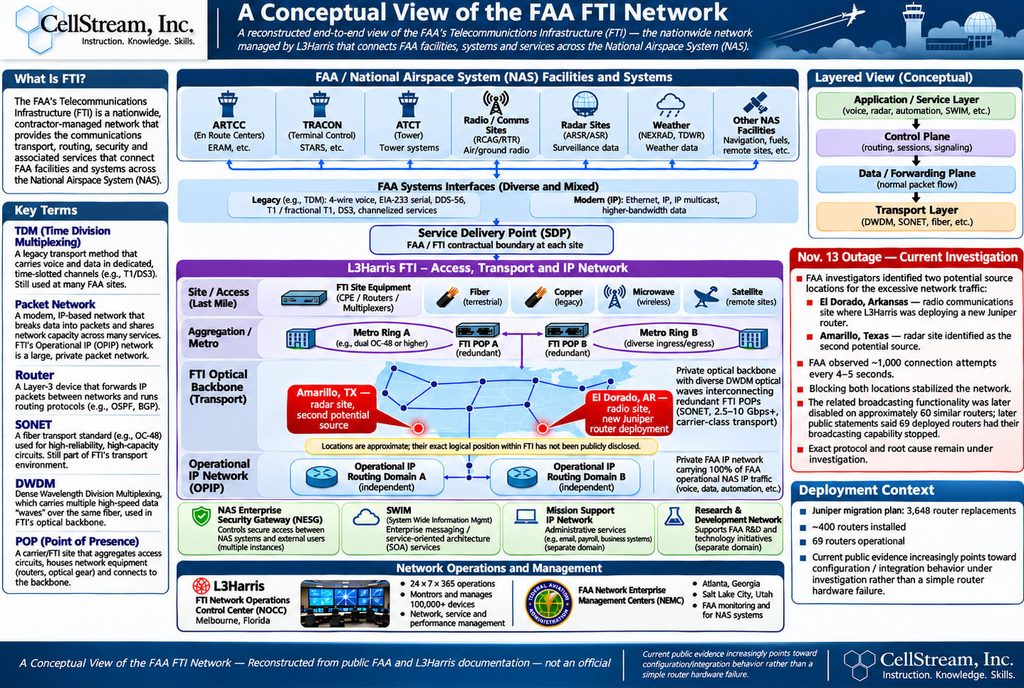
It is important to understand what this diagram is — and what it is not. It is not an official FAA network diagram. It does not show actual current router addressing, routing-protocol adjacencies, interfaces, security policies, carrier assignments or exact physical paths. It is instead a derived conceptual architecture, assembled from information the FAA and L3Harris have publicly disclosed over many years combined with my 30+ years experience in both TDM and modern Data Networking.
Part 3 — FAA Outage Update: El Dorado, Amarillo and the Mysterious “Broadcasting Function”
An examination of the two remote sites, the broadcasting mystery, control-plane possibilities and technical mechanisms worth investigating.
Read Part 3
Part 4 — FAA Outage Update: The Investigation Turns to Configuration and Compatibility
You are here.
Future updates: I will continue following the FAA, L3Harris, HPE/Juniper and Cisco investigation and will add additional technical updates as meaningful new information becomes available.
Sources and References
Federal Aviation Administration — “Nationwide Ground Stop: Questions and Answers,” November 15, 2026
Primary FAA description of the approximately 1,000 connection attempts every four to five seconds, El Dorado and Amarillo, impact on 17 of 22 ARTCCs, and the disabling of the relevant functionality on approximately 60 similar routers.
U.S. Department of Transportation — November 15, 2026 investigation update
Secretary Duffy describes the activation of the El Dorado router, subsequent behavior at Amarillo, laboratory examination of the equipment and the continuing root-cause investigation.
ABC News — November 15–16, 2026
Includes HPE’s statement that the Juniper device functioned as configured by the installer and did not itself fail or act improperly, along with Duffy’s statement that 69 deployed routers had their broadcasting capability disabled.
Reuters — November 16, 2026
Reports that HPE says the equipment worked as configured and that officials are examining why the installation triggered such a widespread disruption.
Reuters — November 17, 2026
Reports information provided by L3Harris to congressional offices indicating that the router transition includes 3,648 Juniper devices, approximately 400 of which have been installed and 69 of which are operational. Also details lawmakers’ requests for testing, independent validation, failover verification and rollback procedures.
CRN — November 16, 2026
Networking-industry reporting on the transition from older Cisco equipment to HPE Juniper routers. An anonymously sourced report suggests the broadcasting capability should have been disabled when communicating with the legacy Cisco environment. This remains an unconfirmed explanation rather than an official FAA root-cause finding.
L3Harris — Statement on the November 13 Ground Stop
L3Harris says it has completed more than 70% of the planned conversion of airspace communications from legacy copper connections to fiber and is supporting the FAA’s investigation.
The technical investigation remains active, and information in this article should be read as a snapshot of what is publicly known as of November 17, 2026.
If you would like to help support the continued development of independent networking, broadband, Wi-Fi, VoIP, and packet analysis content, please consider joining our Patreon community where you will gain access to exclusive technical resources, downloadable labs and PCAPs, bonus course content, troubleshooting guides, and additional member-only material. Comments and technical discussion are always welcomed at our Patreon community or on our Discord server. You can also support our work by simply buying us a coffee — every contribution helps us continue creating practical, real-world network science education for professionals and enthusiasts alike.