

Another FAA Outage: What We Know
What we know as of November 15, 2026
On Friday, November 13, the Federal Aviation Administration issued a nationwide ground stop after telecommunications problems began affecting the stability of radar and communications systems used by air traffic controllers.
The disruption was extraordinary. The problem affected 17 of the FAA’s 22 Air Route Traffic Control Centers, and tens of thousands of flights were ultimately delayed or canceled as the effects propagated through the airline system. The FAA says no air traffic facility completely lost communications, but the information reaching controllers became sufficiently unreliable that the agency stopped departures nationwide while approximately 3,500 aircraft already airborne were safely brought down.
We now know considerably more about the event than we did Friday afternoon.
Unfortunately, some of the explanations being offered in both official statements and news coverage have also blurred several very different networking concepts:
- TDM versus IP.
- Copper versus fiber.
- Analog versus digital.
- Old routers versus new routers.
Those terms are related to the FAA’s modernization effort, but they do not mean the same thing. Understanding the differences is important if we want to understand what actually failed.
What Apparently Happened
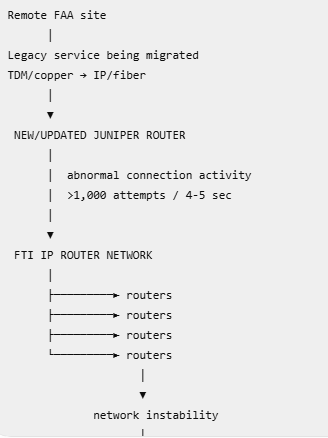
According to the Department of Transportation’s November 14 briefing, contractor L3Harris was performing routine telecommunications maintenance at at least one remote FAA location.
The work involved moving an existing service from aging copper infrastructure onto fiber as part of the FAA’s continuing migration away from legacy Time Division Multiplexing, or TDM, services and toward IP-based telecommunications.
During that work, a router apparently began generating an extraordinary number of connection attempts toward other routers in the FAA telecommunications network.
Transportation Secretary Sean Duffy described the traffic as more than 1,000 connection attempts every four to five seconds.
The traffic propagated through the network and caused instability affecting communications with aircraft as well as radar feeds. Eventually, 17 of the FAA’s 22 en-route air traffic control centers were affected.
The Professional Aviation Safety Specialists union, which represents FAA technical employees, subsequently said the incident had been isolated to two contractor-owned and maintained routers that were being updated during the day. FAA technicians represented by PASS were not performing those upgrades.
The precise initiating cause remains under investigation.
Possible explanations being examined include an installation or configuration error, inappropriate behavior associated with the replacement equipment, or some interaction between the equipment and the existing network.
That distinction matters.
We know much more about the failure than we did Friday, but we still do not have a complete root-cause analysis.
A Brief Timeline
The sequence of events also helps put the technical discussion into perspective.
Friday, November 13 — 3:36 p.m. Eastern: According to Transportation Secretary Duffy, the FAA began experiencing instability in radar and communications systems at centers and TRACONs around the country.
Shortly afterward: The FAA began restricting traffic as technicians investigated the telecommunications failure. By approximately 3:54 p.m. Eastern, the FAA Air Traffic Control System Command Center had issued a national ground-stop advisory. The FAA subsequently expanded and maintained the restriction as en-route facilities attempted to recover.
During the afternoon and evening: Approximately 3,500 aircraft were already airborne as the FAA dealt with the failure. Controllers and pilots continued handling those aircraft while departures were held on the ground.
8:15 p.m. Eastern: The FAA reopened the national airspace to departures. That did not mean airline operations immediately returned to normal. Aircraft, crews and passengers were displaced throughout the system, and airlines faced a substantial recovery operation.
Saturday, November 14: DOT and FAA officials provided the first detailed technical explanation. They said the problem developed during telecommunications work at a remote location where a router being installed or replaced began flooding other routers with more than 1,000 connection attempts every four to five seconds. The resulting instability ultimately affected 17 of 22 en-route centers.
Expected behaviorSite A ─────► intended peersWhat apparently happened ┌──► Router ├──► RouterSite A ── flood ─────┼──► Router ├──► Router ├──► Router └──► Router
Saturday and Sunday: The FAA reported that the telecommunications network remained stable, but the operational consequences continued as airlines attempted to reposition aircraft and crews. Thousands of additional flights were canceled or delayed during the recovery.
That timeline is useful because the story changed significantly between Friday afternoon and Saturday. The initial description was essentially “communications and radar instability.” Only later did we begin learning about the router maintenance, the connection attempts and the relationship to the FAA’s continuing telecommunications migration.
First, Let’s Separate TDM from IP
Much of the discussion surrounding the outage has focused on the FAA’s old TDM telecommunications infrastructure.
TDM stands for Time Division Multiplexing.
In a traditional TDM system, communications channels receive predetermined portions of transmission time.
Conceptually:
A | B | C | D | A | B | C | D
Each channel receives its assigned time slot.
This is fundamentally different from an IP packet network, where packets from many applications and devices statistically share network resources and are forwarded through switches and routers.
In a packet network, traffic may contend for interfaces, queues, buffers, processor resources and other shared resources.
That distinction becomes important when someone says a network was “overloaded with data.”
The phrase makes intuitive sense when discussing packet networks.
It is much less meaningful when applied generically to TDM.
TDM Does Not Mean Analog
Another point deserves clarification because even some of the official explanations have blurred this distinction.
During the November 14 briefing, Secretary Duffy described the FAA as moving:
from copper to fiber, from TDM to IP, and from analog to digital.
Those may all be occurring as part of the FAA’s modernization effort, but they describe three different things.
Copper versus fiber describes the physical transmission medium.
TDM versus IP describes different approaches to transporting and multiplexing communications.
Analog versus digital describes how information is represented.
They are not interchangeable.
For example:
A T1 circuit is a digital TDM service.
TDM can be transported over fiber.
Ethernet and IP can operate over copper.
Digital voice can travel across a TDM system.
TDM circuits can even be emulated across packet networks.
So:
TDM ≠ analog
and
IP ≠ fiber
This may seem like networking trivia, but it becomes important when trying to determine what failed.
The FAA Network Is Already a Hybrid Network
The FAA is not operating one enormous TDM network that will someday suddenly be replaced by an IP network.
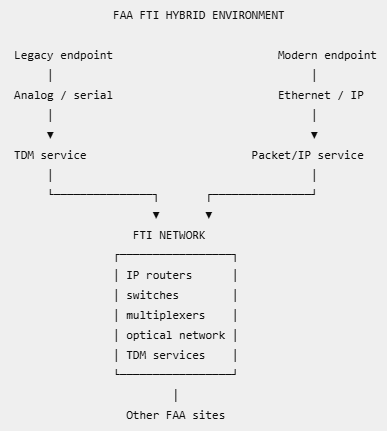
The transition has been underway for years.
FAA documentation describes the National Airspace System operational telecommunications environment as supporting both TDM-based and IP-based services.
A 2015 FAA TDM-to-IP migration document stated that although more than 90% of approximately 23,000 services obtained through the Federal Telecommunications Infrastructure contract were then TDM-based, the operational network already supported a combination of TDM and IP interfaces.
The FAA formally directed programs in 2019 to move toward standardized Ethernet interfaces and Internet Protocol for ground-to-ground, air-to-ground, intra-facility and inter-facility voice and data communications.
Today, therefore, legacy TDM services and packet networking coexist.
That distinction helps explain how a maintenance activity associated with a TDM-to-IP migration could result in what increasingly appears to have been a packet-network problem.
What About the “Old Routers”?
This is another area where the story changed significantly during the first 24 hours.
On Friday evening, the initial explanation was that old FAA switches and routers had become overloaded with data while newer IP equipment continued operating.
Secretary Duffy said:
“Our switches, our routers actually got overloaded with data…”
and contrasted those devices with newer IP equipment.
That understandably created the impression that aging routers simply collapsed under excessive traffic.
By Saturday, however, FAA Administrator Bryan Bedford gave a more nuanced description.
He explained that the incident occurred during routine maintenance of the existing FAA telecommunications infrastructure, not as part of the larger new air traffic control modernization program.
The FAA is continually replacing aging Cisco routing equipment with newer Juniper routers while it keeps the existing network operating.
Bedford specifically cautioned against conflating that maintenance with the broader modernization program.
PASS then reported that the problem had been isolated to two contractor-owned routers being updated that day.
So the simple narrative:
Old routers failed; new routers worked
does not adequately describe what investigators currently believe happened.
The more accurate description appears to be:
Work involving replacement or updated routing equipment caused abnormal traffic that propagated into the existing FAA network, where other equipment was unable to tolerate the resulting condition.
That is a considerably different networking problem.
1,000 Connections Every Four or Five Seconds
This may ultimately be one of the most interesting technical details.
According to DOT, the offending equipment produced more than 1,000 connection attempts every four to five seconds.
That equates to roughly:
200 to 250 connection attempts per second.
For a modern router, 250 ordinary packets per second is trivial.
Even many thousands of packets per second would ordinarily be unremarkable.
That means the important word in the government’s explanation may not be traffic.
It may be connections.
What kind of connections?
We don’t yet know.
Were these TCP connection attempts?
Routing-protocol neighbor relationships?
Management sessions?
Multicast-control messages?
Keepalives?
Attempts to establish some proprietary FAA telecommunications service?
Something associated with a TDM-to-IP gateway?
That information has not yet been publicly established.
And it matters because a router’s forwarding plane may be capable of processing millions of packets every second while its control plane can become overwhelmed by a much smaller number of events that require CPU processing, state creation, authentication or protocol handling.
In other words:
Packet rate and processing load are not necessarily the same thing.
Saying that the routers received “too much data” may therefore describe the visible symptom without explaining the actual problem.
Forwarding Plane Versus Control Plane
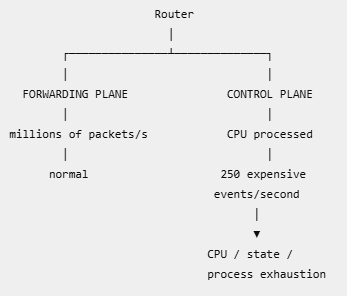
This is another distinction that may become important as the investigation progresses.
Most traffic passing through a router is handled by its forwarding plane.
The router looks up the destination and forwards the packet.
Modern networking equipment can perform that operation extraordinarily quickly.
But some traffic must be processed by the router itself.
That is the control plane.
Routing protocols, management traffic, certain exception conditions and various network-control functions can require CPU or software processing.
A network device capable of forwarding enormous volumes of normal traffic can therefore still become unstable if comparatively small amounts of pathological traffic are directed toward the wrong processing resources.
We do not yet know that a control-plane overload caused the FAA outage.
But until we know what those 1,000 connection attempts actually represented, simply saying that “too much data overloaded the routers” is technically incomplete.
Perhaps the Most Important Question: Why Did It Spread?
This is where the incident becomes especially interesting from a network-design perspective.
A router at a remote FAA location apparently developed a problem.
Why was that problem capable of affecting infrastructure supporting 17 of 22 Air Route Traffic Control Centers?
A properly resilient network does not merely provide redundant links and devices.
It also attempts to control the blast radius of a failure.
Network engineers use mechanisms such as:
- segmentation,
- route isolation,
- rate limiting,
- control-plane policing,
- storm control,
- access controls,
- protocol filtering,
- fault domains,
- redundancy,
- change-control procedures,
- staged deployment,
- and monitoring
specifically to prevent a problem in one portion of a network from destabilizing the entire system.
The eventual FAA technical report needs to answer more than:
What went wrong with the router?
It should also answer:
Why was that router capable of affecting so much of the national network?
That may ultimately be the more important architectural question.
This Was Not Simply a TDM Failure
The FAA absolutely has a legacy-technology problem.
That is not in dispute.
An independent NAS Safety Review Team concluded in 2023 that the aging Federal Telecommunications Infrastructure represented a significant operational risk. The report specifically identified the FAA’s dependence on obsolete TDM telecommunications services and the increasing difficulty obtaining replacement parts and maintaining expertise for aging systems.
The FAA needs to replace that infrastructure.
But that does not mean every failure occurring during the transition can accurately be described as a “TDM problem.”
Based on what we currently know, Friday’s outage appears to have occurred while transitioning a service from legacy TDM infrastructure toward IP, but the mechanism that propagated the failure appears to have involved routers and packet-network behavior.
Those are very different statements.
Copper Wasn’t the Problem Either
Likewise, the fact that copper was being replaced by fiber does not mean copper caused this outage.
Copper infrastructure may be old.
The carrier may be discontinuing the service.
Fiber may provide greater capacity and reliability.
Migrating away from copper may be entirely appropriate.
But none of those facts demonstrates that the copper medium caused Friday’s failure.
The incident occurred during the migration.
That is not the same as saying the old transmission medium caused it.
This distinction is important because otherwise virtually every component of the legacy network gets lumped together under the word old:
- old copper,
- old TDM,
- old routers,
- old switches,
- old radar,
- old communications equipment.
Some of those systems unquestionably need replacement.
But good troubleshooting requires identifying which component actually failed and why.
What We Know — and What We Don’t
At this point, several things appear reasonably well established.
The nationwide ground stop resulted from instability affecting FAA radar and communications services.
The problem affected 17 of 22 en-route centers.
Contractor L3Harris was performing routine telecommunications work associated with moving legacy services toward fiber/IP infrastructure.
One or more routers involved in that work began generating a very large number of connection attempts toward other routers.
The problem was eventually isolated to two contractor-owned and maintained routers.
The FAA isolated the affected equipment and restored network stability.
The event disrupted tens of thousands of flights, and the airline system continued recovering throughout the weekend.
But important technical questions remain unanswered:
- What exactly were the connection attempts?
- What protocol generated them?
- Why were they generated?
- Was this configuration error, software behavior, hardware failure or some combination?
- Which devices actually became overloaded?
- What resource was exhausted — bandwidth, CPU, memory, session state or something else?
- How did the traffic propagate across such a large portion of the FAA network?
- What mechanisms existed to contain such an event, and why did they not contain it?
- Why was maintenance at a remote location capable of producing a nationwide operational consequence?
Those answers will tell us far more than simply knowing whether a particular cable was copper or fiber.
The Networking Lesson
This outage is already providing a useful networking lesson.
Terminology matters.
Copper is not synonymous with TDM.
Fiber is not synonymous with IP.
TDM is not synonymous with analog.
IP is not synonymous with digital.
And “old equipment” is not a root cause.
Networks are systems composed of physical media, interfaces, switching and routing technologies, protocols, applications, control mechanisms and operational procedures.
When something goes wrong, troubleshooting requires separating those layers rather than combining them.
For now, the most accurate description of the November 13 FAA outage appears to be this:
A telecommunications maintenance operation associated with the FAA’s continuing TDM-to-IP migration resulted in abnormal connection activity from routing equipment. That activity propagated through the FAA’s existing telecommunications network, destabilizing radar and communications services across much of the National Airspace System and forcing a nationwide ground stop.
We still don’t know exactly why.
And until the FAA and its contractors provide the protocol-level and equipment-level details necessary to answer that question, claims that the outage was simply caused by “old TDM,” “old copper,” “old routers” or even “too much data” should be treated as descriptions, simplifications or speculation — not a technical root-cause analysis.
I will follow up with some answers as they become available.
If you would like to help support the continued development of independent networking, broadband, Wi-Fi, VoIP, and packet analysis content, please consider joining our Patreon community where you will gain access to exclusive technical resources, downloadable labs and PCAPs, bonus course content, troubleshooting guides, and additional member-only material. Comments and technical discussion are always welcomed at our Patreon community or on our Discord server. You can also support our work by simply buying us a coffee — every contribution helps us continue creating practical, real-world network science education for professionals and enthusiasts alike.