

What we know as of November 24, 2026
We finally have a significant technical development in the investigation of the November 13 FAA nationwide ground stop.
For more than a week, public descriptions of the incident have referred to a new Juniper “router,” a mysterious “broadcasting function,” and approximately 1,000 “connection attempts” every four to five seconds flooding the FAA Telecommunications Infrastructure, or FTI, network. If you have read the posts from the beginning, some of that terminology has bothered me from the beginning.
Now HPE CEO Antonio Neri has provided the clearest description yet of the equipment involved and, importantly, has finally put a name to the mysterious broadcasting function. According to Neri, the device involved was not a conventional Juniper router. It was an HPE Juniper Circuit to Packet, or CTP, platform.
And the feature that had been enabled? Multicasting.
Neri told CRN that HPE’s position remains that the equipment operated as configured and that a multicast feature had been enabled even though it was not necessary for this particular use case.
That moves this investigation forward considerably. It also raises some very specific new networking questions.
This Was a CTP Platform, Not Simply a Router
This clarification matters. HPE describes the Juniper CTP platform as technology designed to bridge legacy TDM and other circuit-based applications into modern IP and MPLS networks. Juniper’s own documentation says CTP platforms create IP packet flows from serial-data or analog-voice connections and recreate the original circuit signal at the remote end. That is very different from the simplified description we have repeatedly heard:
old copper → new fiber → new router
The transition is potentially much more interesting than that. Conceptually, the CTP’s role looks more like this:
Legacy FAA circuit-based service -> TDM / serial / analog voice -> CTP circuit-to-packet platform -> IP packet transport -> FTI packet network -> remote service endpoint
Juniper’s product documentation specifically describes CTP as supporting legacy circuit applications across IP and IP/MPLS networks, including TDM trunks, serial circuits, analog radio applications, and other synchronous services. So this was not simply a physical-layer media conversion from copper to fiber. The device was participating in the conversion of legacy circuit-based services into packet transport. That is a much more meaningful networking change.
But Let’s Not Jump to MPLS
This deserves an important qualification. Because CTP supports IP/MPLS transport, it is tempting to immediately start looking at MPLS pseudowires, SAToP, CESoPSN, or other circuit-emulation mechanisms.
We explored those technologies while trying to understand what a CTP platform actually does. But we currently have no evidence that an MPLS pseudowire failure caused the FAA incident. Juniper’s CTP product supports those technologies. That does not mean the El Dorado configuration used them in the way involved in this failure. Product capability is not evidence of incident mechanism. So for now I am keeping MPLS and pseudowires in the background until investigators provide the actual configuration or packet-level information.
The “Broadcasting Function” Finally Has a Name
The more important disclosure from HPE is multicast. Until now, the FAA has repeatedly described a “broadcasting function” on the newly deployed equipment. The FAA’s current Q&A says that after investigators isolated El Dorado and Amarillo, the “broadcasting function” was disabled on the new Juniper devices. The FAA subsequently disabled the same functionality on more than 60 similar devices as a precaution.
That wording was frustratingly vague.
- Was this Ethernet broadcast?
- IP multicast?
- A proprietary replication mechanism?
- Service discovery?
- Telemetry?
- Routing advertisements?
- Application-level distribution?
We didn’t know. Now HPE’s CEO is specifically calling the feature multicasting. That is much more useful. But it is still not enough to determine the root cause.
“Multicast” Is Still Not a Root Cause
Multicast is a traffic-distribution mechanism. It allows a source to send traffic intended for multiple receivers without having to transmit a separate copy for every recipient at the source. There is nothing inherently abnormal or dangerous about multicast. It is widely used in enterprise, service-provider, financial, video, industrial, military, and other specialized networks.
So saying: multicast was enabled does not explain: why the FAA network became unstable.
We still need to know what the multicast function was doing.
- Was the CTP generating IP multicast?
- Was it transporting an application that used multicast?
- Was it replicating circuit traffic toward multiple receivers?
- Was multicast being used for service redundancy?
- Was some discovery or registration mechanism involved?
- What multicast group addresses were involved?
- How many receivers existed?
- Were multicast boundaries or filters configured?
- What happened when the traffic reached the older infrastructure?
Those are the technical details that turn the word “multicast” into an actual root-cause explanation.
By the way, if you want to learn a little multicast, I will put a shameless plug here for my lab on Patreon: https://www.patreon.com/cellstream/posts/ipv4-multicast-165754150
HPE Says Multicast Was Not Necessary
This may be the most consequential part of Neri’s statement. HPE says the multicast feature was not necessary for this use case.
That immediately raises the configuration-management question we have been discussing throughout this series of posts: If multicast was unnecessary, why was it enabled?
That question becomes particularly important because HPE also says the product operated as configured. Those two statements together suggest something very different from a spontaneous hardware failure.
The emerging picture is potentially: CTP platform installed -> multicast capability enabled -> device operates according to configuration -> unexpected network behavior occurs -> FTI network becomes unstable
Notice the distinction.
That does not mean HPE has established that multicast alone caused the outage. It means the investigation is increasingly pointing toward configuration and system interaction, rather than a CTP platform simply malfunctioning. That is precisely why the Method of Procedure, engineering change documentation, configuration baseline, testing plan, and acceptance criteria have become so important.
Was Multicast Enabled by Default?
There is another potentially important detail, although it remains less authoritative.
Before Neri’s comments, Network World cited a source close to the investigation who said that the CTP multicast feature is shipped disabled and requires explicit configuration to enable. The source characterized it as something requiring configuration rather than merely flipping an automatic default. That statement has not, to my knowledge, been publicly confirmed by HPE in the same level of detail. So I would still treat it cautiously. But if it proves correct, the question becomes considerably sharper. Multicast would not merely have been something someone forgot to disable.
Someone—or some configuration template—would apparently have enabled it.
That raises several obvious questions:
- Was it intentionally included in the approved configuration?
- Was it inherited from a standard template?
- Was it needed at another FAA site but unnecessary at El Dorado?
- Was the configuration copied from another deployment?
- Was the multicast feature present on the previous 68 successful installations?
- And did the approved engineering configuration actually match what was placed into service?
Those should now be straightforward questions for the investigation to answer.
The Previous 68 Installations Matter Even More
Government officials have said that El Dorado represented approximately the 69th operational deployment and that the previous 68 installations had not produced this failure. CRN’s latest reporting repeats that account. Assuming that information is accurate, we now have a valuable comparison.
Were those previous devices also configured for multicast? If yes, then multicast alone cannot explain what was unique about El Dorado. Something else must distinguish installation 69 from installations 1 through 68. If no, then the multicast configuration becomes considerably more significant.
This is the type of comparison that should be relatively easy to perform during a root-cause analysis. Take a known-good installation. Compare it with El Dorado. Diff the configurations. Compare software versions. Compare connected services. Compare peer devices. Compare multicast settings. Compare traffic flows. Compare the commissioning procedure.
The differences should narrow the investigation dramatically. This is not hard people. Anyone with just a handful of networking experience would have the answers to this in an hour.
Amarillo Still Must Be Explained
And we still have Amarillo. According to the FAA, investigators identified both the El Dorado radio communications site and the Amarillo radar site as potential origins of excessive network traffic. Blocking those two sites stabilized the network. Previous reporting indicated that the Amarillo equipment had been installed weeks earlier without causing a nationwide incident.
Then El Dorado came online. Somehow Amarillo became involved in the abnormal behavior. Any credible root-cause explanation therefore has to explain both ends of that relationship.
Simply saying: El Dorado had multicast enabled is incomplete.
- Why did Amarillo react?
- Were both devices members of the same multicast group?
- Did one device’s activation cause the other to begin transmitting?
- Were they participating in some common service?
- Was there a shared management or configuration relationship?
- Was Amarillo receiving traffic and responding to it?
- Was a third network element coordinating the interaction?
We still don’t know. But the identification of multicast makes those questions more concrete than they were a few days ago.
And What Were the “1,000 Connection Attempts”?
This remains the terminology that bothers me the most. The FAA continues to describe approximately 1,000 connection attempts every four to five seconds flooding the FTI network. But multicast traffic is not ordinarily described as establishing thousands of “connections.” Multicast is normally connectionless packet distribution.
That suggests at least three possibilities.
- The FAA may be using “connection attempts” as nontechnical shorthand for packets, transactions, registrations, or some other events.
- The multicast traffic may have triggered secondary connection attempts elsewhere in the network.
- Or multicast may be only one part of a more complicated failure sequence.
Until investigators tell us what those 1,000 events actually were, we cannot confidently connect that statement to the multicast disclosure. This is exactly why packet-level terminology matters.
- Were they TCP SYNs?
- UDP datagrams?
- CTP circuit-establishment messages?
- Management transactions?
- OAM packets?
- Multicast joins?
- Application registrations?
- Routing or control-plane messages?
- Something else?
Calling all of those things “connections” hides the information we need.
What Kind of Multicast?
Even the word multicast still leaves an important layer question unanswered. Are we talking about:
- Ethernet multicast at Layer 2?
- IP multicast at Layer 3?
- A CTP-specific one-to-many service function?
- Application-level replication that HPE is describing generically as multicast?
HPE’s comments identify the feature but do not provide enough protocol detail to answer that question.
That distinction matters enormously. For example, Layer-2 multicast behavior inside a bridged Ethernet service has very different propagation characteristics from routed IP multicast using IGMP and PIM. Likewise, a proprietary CTP service replication mechanism could behave differently from either one.
So we have finally learned what HPE calls the feature.
We still need to learn how the feature actually operates in this FAA deployment.
HPE’s Statement Also Clarifies Responsibility Boundaries
Neri made another notable point in his CRN interview. He emphasized that L3Harris is the network operator responsible for installing devices, managing them, monitoring the network, and operating the environment.
That does not establish blame. But it does reinforce something we discussed in Part 5.
If HPE supplied a CTP platform that operated according to its configuration, then the investigation must examine the entire operational chain:
- who designed the configuration;
- who approved multicast for the deployment;
- who loaded the configuration;
- who tested the resulting service;
- whether the configuration matched the approved engineering baseline;
- whether previous installations used the same template;
- what monitoring should have detected the abnormal traffic;
- and what network controls should have prevented one remote-site event from affecting 17 of 22 ARTCCs.
Those are change-management and network-engineering questions. They are not questions about whether Juniper hardware simply “worked” or “failed.”
The FAA Has Not Yet Declared the Root Cause
There is one final distinction worth emphasizing. HPE’s disclosure is significant, but it is not yet the official FAA root-cause report. The FAA’s current public Q&A still says that the FAA and L3Harris continue to investigate the root cause.
So I would characterize today’s development this way:
- We now know substantially more about the device.
- We now know substantially more about the feature.
- We still do not know the complete failure mechanism.
That mechanism should ultimately connect the following facts:
CTP installation at El Dorado -> multicast enabled even though HPE says it was unnecessary -> approximately 1,000 reported “connection attempts” every four to five seconds -> Amarillo also becomes involved -> legacy FTI equipment becomes unstable -> 17 of 22 ARTCCs experience instability -> L3Harris eventually isolates El Dorado and Amarillo -> network stabilizes
The root-cause report has to connect every one of those dots.
What I Want to Know Next
At this point, the remaining questions are becoming much more precise:
- What exact CTPOS feature or configuration command enabled multicast?
- Was multicast enabled on the previous 68 operational CTP installations?
- Was it included in the approved configuration template for El Dorado?
- Was the traffic Ethernet multicast, IP multicast, or another CTP service mechanism?
- What multicast addresses or groups were involved?
- What exactly were the FAA’s “1,000 connection attempts”?
- Why did Amarillo change behavior when El Dorado was activated?
- What received the traffic on the older Cisco infrastructure?
- What resource became unstable or exhausted?
- Why didn’t multicast controls, rate limiting, control-plane protection, or other fault-containment mechanisms stop the propagation?
- Why did it take the network operations organization so long to identify and isolate the originating sites?
Those are no longer speculative questions about whether multicast might have been involved. HPE has now told us that multicast was enabled. The remaining job is to understand exactly what that multicast configuration did.
Where We Stand
The public explanation has changed substantially since November 13:
- First, we heard about old TDM equipment and aging routers.
- Then we learned about El Dorado and Amarillo.
- Then we heard about a mysterious “broadcasting function.”
- Then the investigation shifted toward configuration, interoperability, monitoring, and change control.
- Now HPE has provided two particularly important technical clarifications.
- The implicated platform was a Juniper Circuit to Packet device, not simply a conventional router.
- And the mysterious broadcasting function was multicasting, which HPE says was enabled even though it was unnecessary for this use case.
That is real progress if not at the speed of a sloth (nothing against sloths, I actually think they are pretty cool). But it still isn’t the root cause. The most important next step is no longer determining whether multicast was involved. It was.
The question is: What did the multicast configuration actually cause the CTP platform and the surrounding FAA network to do? Once we have that answer, we should finally be able to replace words such as “broadcasting,” “flooding,” and “connection attempts” with actual protocols, packets, addresses, groups, rates, and network behavior.
That is the explanation I am still waiting for.
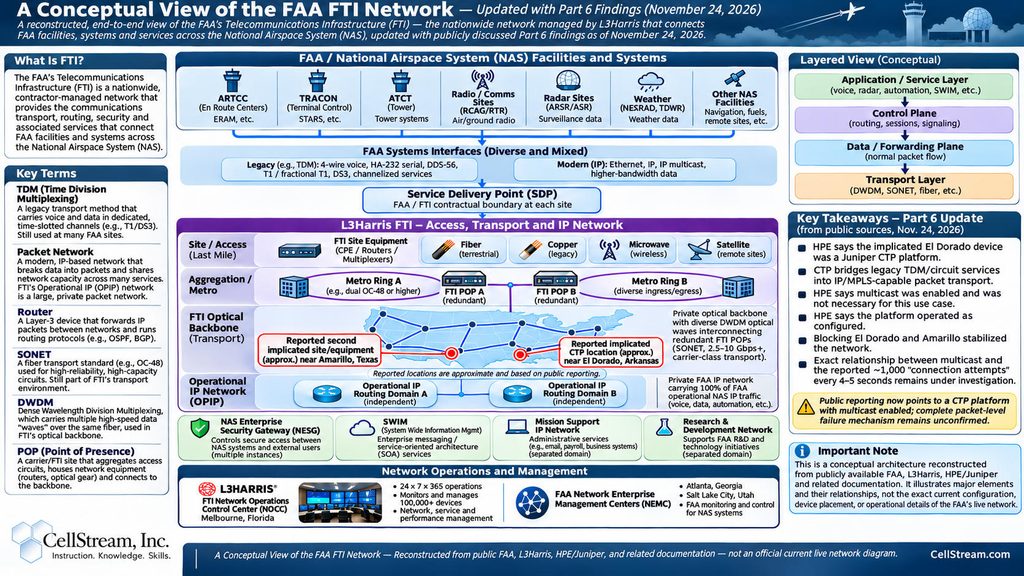
An Update to my Info Graphic
Remember, this is purely conceptual on my part and I will continue to try to update as more questions are answered:
FAA Outage Series
This article is Part 6 of my continuing technical analysis of the November 13 FAA outage.
Part 1 — Another FAA Outage: What We Know
The initial analysis separates TDM, IP, copper, fiber, analog/digital, and router terminology.
Read Part 1
Part 2 — FAA Outage Follow-Up: What We Have Learned About the Network
A deeper look at L3Harris, FTI, and a derived conceptual view of the FAA telecommunications architecture.
Read Part 2
Part 3 — FAA Outage Update: El Dorado, Amarillo and the Mysterious “Broadcasting Function”
The investigation narrows to El Dorado and Amarillo and the still-unexplained broadcasting behavior.
Read Part 3
Part 4 — FAA Outage Update: The Investigation Turns to Configuration and Compatibility
The investigation shifts toward configuration, interoperability, deployment testing, and engineering change control.
Read Part 4
Part 5 — FAA Outage Update: Questions Shift to Monitoring, Oversight and Change Control
The investigation expands into network observability, fault isolation, monitoring, and the approved change process.
Read Part 5
Part 6 — FAA Outage Update: HPE Confirms Multicast Was Enabled
You are here.
I will continue following the FAA, L3Harris, HPE/Juniper, and Cisco investigation and add additional technical updates as meaningful new information becomes available.
Sources and References
HPE CEO Antonio Neri interview with CRN — November 23, 2026
Neri identifies the implicated equipment as an HPE Juniper CTP platform, says the product operated as configured, and states that multicast was enabled even though it was not necessary for the use case.
Read the CRN article
Federal Aviation Administration — Nationwide Ground Stop: Questions and Answers
The FAA’s current official description of the November 13 outage, including the reported 1,000 connection attempts every four to five seconds, El Dorado and Amarillo, the disabled “broadcasting function,” and the continuing root-cause investigation.
Read the FAA Q&A
HPE Juniper Networking — CTP Series Documentation
Official product documentation describing CTP platforms as systems for transporting legacy TDM and other circuit-based applications across next-generation IP networks.
View the CTP Series documentation
HPE Juniper Networking — CTP Series Circuit to Packet Platforms Datasheet
Describes the CTP product family, its circuit-emulation capabilities, and support for transporting legacy TDM, serial, analog voice, and other circuit-based services across IP/MPLS networks.
View the CTP Series datasheet
HPE Juniper Networking — CTP Series Product Overview
Provides an overview of the CTP151, CTP2008, CTP2024, and CTP2056 platforms and describes their role in bridging legacy circuit-switched applications into IP networks.
View the CTP Series product page
Network World — FAA Halts Router Installs as Experts Question How One Change Grounded the Nation
Earlier reporting on the CTP equipment, the FAA’s deployment pause, and anonymously sourced information concerning the multicast capability and configuration. These details remain secondary reporting rather than an official FAA root-cause finding.
Read the Network World article
If you would like to help support the continued development of independent networking, broadband, Wi-Fi, VoIP, and packet analysis content, please consider joining our Patreon community where you will gain access to exclusive technical resources, downloadable labs and PCAPs, bonus course content, troubleshooting guides, and additional member-only material. Comments and technical discussion are always welcomed at our Patreon community or on our Discord server. You can also support our work by simply buying us a coffee — every contribution helps us continue creating practical, real-world network science education for professionals and enthusiasts alike.