

1-Day Instructor-Led Course
On Site, Instructor Led
Also Available for Web-Based and Self-Paced Online Delivery as an 8 hour online class which must be completed in 30 days of beginning the course: click here to go to the Online Classes category at our online school.
What Students are Saying about this class:
- “Great class. Very information packed. In-depth for a 101 class. A++”
- “Currently employed for 3 months when I took this course. I think the 20 yr guys could use this too”
- “I liked the labs associated with this course because it did a great job reviewing items learned” and “The first lab is a little rough, did not expect it. Started paying much more attention.”
- “The instructor goes over examples and explaining everything in detail – You did a great job going over everything in the Telecom 101 course! Thank you!”
- “I liked the PDF of the slides that you can take notes on.”
- “I liked that you could see the answers to the quizzes afterward so that you can learn from it.”
- “Explains everything really well – great job with the entire class”
- “Very informative, gives greater understanding – just as course is properly named ‘101’”
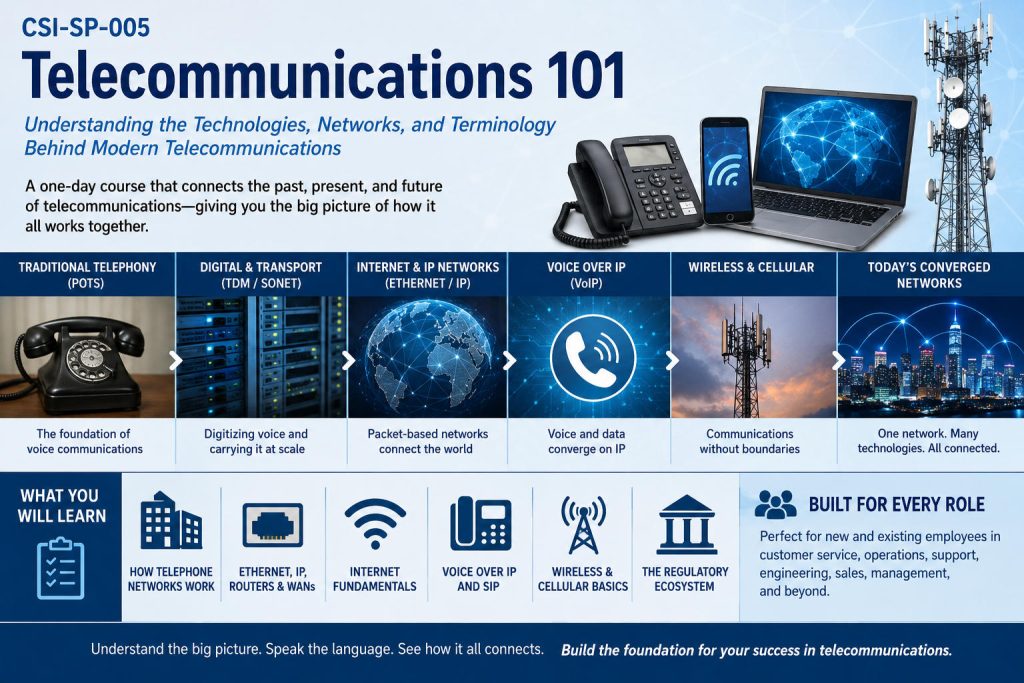
Understanding the Technologies, Networks, and Terminology Behind Modern Telecommunications
The telecommunications industry combines more than a century of telephone technology with today’s broadband Internet, IP networking, wireless communications, Voice over IP, and rapidly evolving service-provider networks. For someone entering the industry, the terminology, acronyms, technologies, and relationships between these systems can quickly become overwhelming.
Telecommunications 101 provides a practical introduction to this complex environment. The course explains how telecommunications networks developed, how their major components work, and how traditional telephone systems evolved into the converged voice, data, broadband, and wireless networks used today.
Rather than concentrating on one particular technology, this course provides the big picture—helping students understand how the pieces of a modern telecommunications service provider fit together.
Course Description
Telecommunications 101 is designed to give new and existing service-provider employees a solid foundation in the technologies, terminology, systems, and business environment of the telecommunications industry.
The course begins with the traditional telephone network, including telephones, local loops, central offices, switching, numbering, trunks, digital voice, multiplexing, and the technologies historically used to transport telephone services.
Students then follow the industry’s transition into modern data communications and the Internet. Ethernet, LANs, WANs, routers, IPv4, IPv6, the OSI model, Internet architecture, and the convergence of voice and data are introduced in a way that does not require an engineering background.
From there, the course examines Voice over IP and how modern IP-based voice architectures perform many of the functions once handled entirely by traditional telephone switches.
The final portion of the course introduces the regulatory ecosystem that affects telecommunications and broadband service providers, helping students understand that delivering communications services involves much more than network technology.
The result is a broad understanding of where telecommunications came from, how today’s networks operate, and how the different technologies and organizations within the industry relate to one another.
Why Telecommunications 101?
Employees joining a broadband or telecommunications company frequently encounter terminology that experienced coworkers use without explanation.
Terms such as:
- Central Office
- Local Loop
- Demarc
- Trunk
- TDM
- SONET
- Ethernet
- IP
- Router
- VoIP
- SIP
- SBC
- PSTN
- FCC
- USF
- ACAM
- BEAD
may all appear during conversations about customers, networks, operations, engineering, billing, regulation, and service delivery.
Understanding these terms individually is useful.
Understanding how they relate to one another is much more valuable.
Telecommunications 101 creates that foundation. It provides employees with a common vocabulary and a broader understanding of the industry so they can communicate more effectively with customers, coworkers, technicians, engineers, managers, and other organizations.
Who Should Attend?
This course is ideal for new employees entering the telecommunications, telephone, broadband, Internet service provider, or related communications industries.
It is also valuable for existing employees who want a broader understanding of technologies or business areas outside their normal responsibilities.
Typical participants include:
- New telecommunications and broadband employees
- Customer service representatives
- Technical support personnel
- Broadband technicians
- Field operations personnel
- Network operations personnel
- Sales and marketing employees
- Billing and administrative personnel
- Supervisors and managers
- Network technicians
- Engineers who want a broader industry perspective
- Employees moving into new telecommunications responsibilities
Because the course explains concepts from the ground up, it is appropriate for both technical and non-technical audiences.
What Students Will Learn
By the end of the course, students should have a better understanding of:
- How the traditional telephone network operates
- How telephone calls historically traveled through the PSTN
- The purpose of central offices, switches, lines, trunks, and local loops
- How analog voice becomes digital information
- How digital voice services are multiplexed and transported
- How traditional telephone and broadband access technologies evolved
- The basic architecture of cellular networks
- What the Internet is and how it developed
- The fundamentals of layered network communications
- Ethernet and Local Area Networks
- IP networks and Wide Area Networks
- The roles of IPv4, IPv6, switches, and routers
- How voice and data networks converged
- The fundamentals of Voice over IP
- The roles of SIP and Session Border Controllers
- The differences between traditional voice networks and modern VoIP architectures
- The regulatory environment affecting telecommunications and broadband providers
- How all of these technologies fit together within a modern service-provider network
A Technology Evolution Story
One of the most important themes of Telecommunications 101 is that today’s telecommunications network did not appear overnight.
Modern broadband networks evolved from earlier communications systems.
The traditional telephone network introduced concepts such as subscriber lines, switching, numbering, trunks, reliability, and large-scale interconnected networks.
Digital communications introduced digitized voice, multiplexing, and high-capacity transmission systems.
Computer networking introduced Ethernet, packet switching, routers, Internet Protocol, and the Internet.
Voice over IP brought voice communications into packet-based networks.
Wireless and cellular technologies extended communications beyond physical network connections.
Today’s telecommunications provider may operate technologies from several generations of this evolution simultaneously.
Understanding that evolution makes today’s network much easier to understand.
Course Prerequisites
There are no technical prerequisites for this course.
Students do not need previous telecommunications, networking, or engineering experience.
The course is specifically designed to introduce telecommunications terminology and technologies in a manner understandable to employees with a wide range of technical backgrounds.
Course Format
This course uses instructor explanations, diagrams, demonstrations, examples, exercises, and discussion to help students connect telecommunications terminology with the actual networks and services used by service providers.
The emphasis is on understanding concepts and relationships rather than memorizing acronyms.
Students leave the course with a valuable reference framework they can continue to build upon as they gain additional telecommunications experience.
Course Outline
Retain the existing CSI-SP-005 Course Outline here unchanged.
The current three major sections remain:
Section 1 – Plain Old Telephone Service (POTS)
Section 2 – The Internetwork / Internet
Section 3 – The Regulatory Ecosystem
The detailed Parts and individual course topics currently listed beneath these sections should remain unchanged.
Course Availability
Telecommunications 101 is available for private and scheduled instructor-led training.
Contact CellStream for current scheduling, delivery options, and class availability.
The course is also available through CellStream’s online training offerings for organizations or individuals who require an alternative to live classroom delivery.
Build a Foundation for Everything Else in Telecommunications
Whether someone works in customer service, field operations, broadband support, engineering, management, sales, or network operations, understanding the larger telecommunications environment makes it easier to understand their own role within it.
Telecommunications 101 provides that foundation.
It connects the terminology, technologies, network functions, and industry concepts that employees encounter every day—and provides the context needed to continue learning as telecommunications networks evolve.
Course Availability:
Contact us for schedule dates and times via our contact form or through the details provided on the page.
View the course calendar and browse for our schedule. It will show scheduled courses and available dates for scheduling.
Course Description, Content, Outline, and Instructional Design are Copyright ©CellStream, Inc.