

I have seen a bunch of posts about IP version 8 supplanting IPv6. Let’s sort this out a bit. I think a full listing of the IP version numbers is needed as a backdrop.
The Internet Protocol (IP) has evolved through a sequence of versions during its research, testing, and operational deployment phases. Not all version numbers were used for production protocols, but each reflects a step in the protocol’s development. The version number is found in the first 4 bits of the IP protocol:
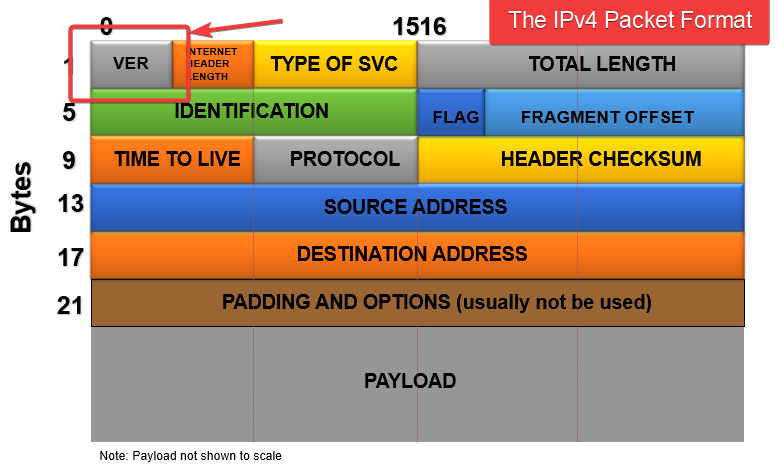
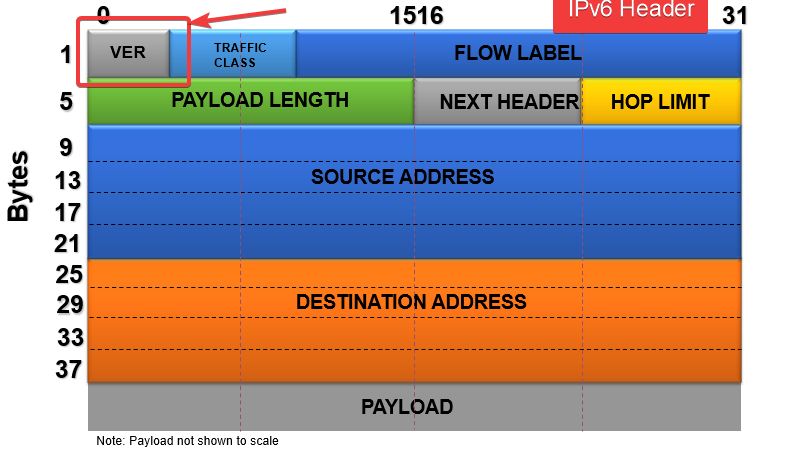
| IP Version Number | Notes |
|---|---|
| v0 – 0000 | Version 0 was described in IEN 2, published in 1977. Version 0 is not a formal protocol but is often used informally to describe the earliest conceptual work on packet-switching and internetworking within the ARPANET research environment in the late 1960s and early 1970s. These efforts laid the groundwork for what became IP. |
| v1 – 0001 | See note in v3. |
| v2 – 0010 | Version 2 was described in IEN 28 from 1978 |
| v3 – 0011 | Versions 1, 2, and 3 were early experimental iterations of the protocol developed as part of the original TCP (Transmission Control Program) work led by Vint Cerf and Bob Kahn in the 1970s. These versions were used internally for testing. At this stage, TCP and IP were not yet separated; they were part of a single protocol. These versions were never standardized or widely deployed. |
| v4 – 0100 | IPv4 is the first production version of IP and remains the most widely used protocol on the Internet. Key characteristics: 32-bit addressing (~4.3 billion addresses), dotted decimal notation (e.g., 192.168.1.1), defined in RFC791 (1981) with features like fragmentation, TTL, and header checksum. |
| v5 – 0101 | IPv5 was not a successor to IPv4 in the traditional sense. Known as the Internet Stream Protocol (ST) and was designed for real-time streaming (voice/video). Specified in RFC1190, it introduced concepts like resource reservation and QoS. v5 remained experimental and was never adopted for general Internet use. |
| v6 – 0110 | Assigned to one of the submissions for the IPng (IP Next Generation) project – this one was assigned to Simple IP by Steve Deering. You can find that draft here. We know today that this one the competition and was designated the official next version of the Internet Protocol. Key characteristics in Deering’s design are 128-bit addressing (virtually unlimited address space), hexadecimal colon-separated notation, a simplified header structure, fixed size header, incorporation of his original invention: Multicast, bringing ICMP and IGMP together, built-in support for IPsec (security) and it eliminates the need for NAT in most designs. As of the writing of this post, IPv6 is now transporting more that 60% of Internet traffic in the US. The standard for IPv6 is here: RFC8200 |
| v7 – 0111 | Assigned to one of the submissions for the IPng project – this one was assigned to CATNIP (formerly TP/IX) which stands for Common Architecture for the Internet. You can read the draft specification here as well as RFC1707. This concept was written by Robert L. Ullmann. |
| v8 – 1000 | It is not clear that this was assigned an IP version – Pip authored by Paul F. Tsuchiya. It was known as Paul’s IP. You will find the draft specification here. In the end this solution was never really considered and no RFC resulted. |
| v9 – 1001 | Assigned to one of the submissions for the IPng project – this one was assigned to TUBA = TCP and UDP with Bigger Addresses (a.k.a. CLNP, the OSI Connectionless Network Layer Protocol) by Peter Ford and Mark Knopper. You can find the draft specification here, as well as the RFC1347. |
Supposedly, only IPv10, IPv11, IPv12, IPv13, and IPv14 are available for future assignment if the same 4 bits of the version number are maintained. But perhaps version 8 is available as well.
Recently I saw posts like this:
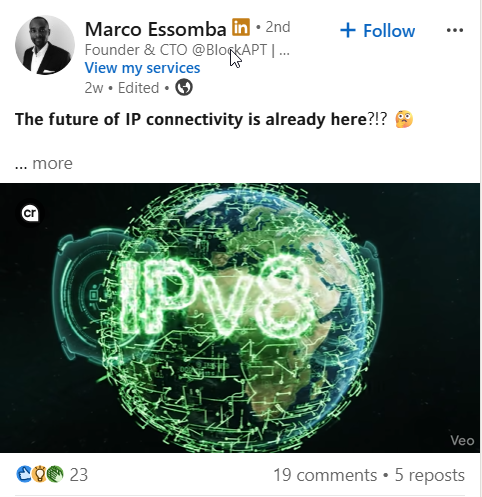
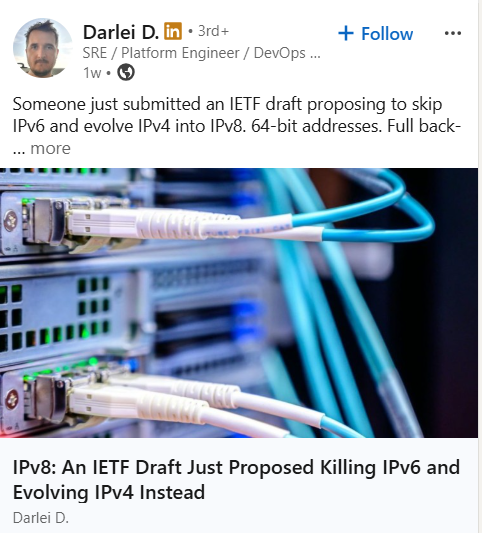
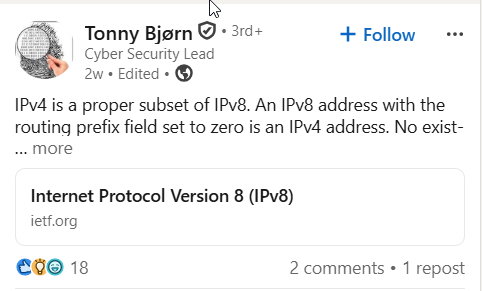
Indeed there is a draft called IPv8 – find it here. A couple of things stand out at initial glance – it is not in the usual multiple IETF draft format. Then again it was just released in April of 2026. The path the file is in is the “archive” not the usual RFC Editor path, which strikes me as weird since something just published should not be “archived”. I immediately hunted the date as on April 1st every year there are “April Fools” RFC’s (you can find a full list of those here). Perhaps this is how the IETF handles non-working group draft publications – obviously not a norm certainly in my experience.
So what is it? Well it is a return to the 64 bit address format idea introduced actually originally by Steve Deering before he expanded it to 128 bits. It is also proposed as essentially a let’s stop mucking about with IPv6 and put in something that everyone adopts. It essentially “wraps” IPv4 keeping IPv4 mostly whole, and then adding 4 additional dot decimal numbers – so r.r.r.r.n.n.n.n where n.n.n.n is the well understood IPv4 address and r.r.r.r is the new IPv8 “wrapper”.
Here is the IPv8 header from the draft proposal:
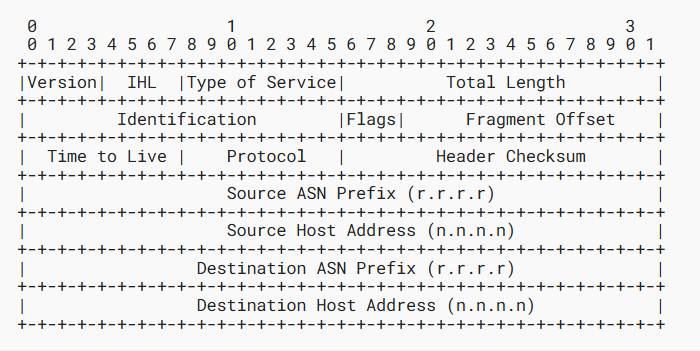
What this means is that like a phone number being extended with extra digits to add area code and/or country codes, each ASN – autonomous system – gets potentially a 32 bit number like a supernetwork (my word). Then each of those supernetworks (again, my word) can have a full IPv4 32 bit set of networks and hosts. The problem with this is unlike IPv6 that provides 2^64 number of devices (OK perhaps overkill) – the host space remains much as it is today. The spec claims this does not require dual stack, but it is not clear to me that is true. In order to introduce this into the network a lot of fiddling with IP packets will be needed – just like any change in addressing. Further all the hardware forwarding in routers today supporting IPv4 and IPv6 will need to be replaced. Yikes.
But that is just the basic numbering change. The proposal changes all routing protocols, adds a bunch of numbering concepts introduced by Deering in IPv6 and more. It calls for these specifications:
- draft-thain-ipv8-00 Core protocol (this document)
- draft-thain-routing-protocols-00 BGP8, IBGP8, OSPF8, IS-IS8, CF
- draft-thain-rine-00 Regional Inter-Network Exchange
- draft-thain-zoneserver-00 Zone Server Architecture
- draft-thain-whois8-00 WHOIS8 Protocol
- draft-thain-netlog8-00 NetLog8 Protocol
- draft-thain-support8-00 ARP8, ICMPv8, Route8
- draft-thain-ipv8-mib-00 IPv8 MIB and SNMPv8
- draft-thain-wifi8-00 WiFi8 Protocol
- draft-thain-update8-00 Update8 and NIC Certification
Back to the weirdness. I concede that it is human nature to doubt when a new idea is brought forward. That is certainly true in the industry recently. In this article Cybernews shows there is a high likelihood it is AI generated.
Cybernews ran the full document through a GPTZero scan, which flagged the largest sections of the document as 100% AI generating and gave a 76% overall probability that the document is AI-generated.
In Hacker News these posts seem to highly doubt validity of this draft spec, and suggest more that it is a marketing ploy. There are also users in that thread that observe the weirdness of having authorization (oAuth) functions down at Layer 3 instead of the application layer where they really belong.
There is a great overview of what the draft introduces, changes or modifies here. So I wont drift into a bunch of further detail – that work has been done by others.
Regardless, the draft requires changes to routing protocols and much more – there are supposedly a spew of additional drafts that go along with this headliner. The true test will be whether a working group actually forms around this work. So stay tuned.
If you would like to help support the continued development of independent networking, broadband, Wi-Fi, VoIP, and packet analysis content, please consider joining our Patreon community where you will gain access to exclusive technical resources, downloadable labs and PCAPs, bonus course content, troubleshooting guides, and additional member-only material. Comments and technical discussion are always welcomed at our Patreon community or on our Discord server. You can also support our work by simply buying us a coffee — every contribution helps us continue creating practical, real-world network science education for professionals and enthusiasts alike.