
I have always said, everywhere – at least at some level. It typically involves governments or authorities blocking or restricting access to certain content, websites, or services. Here’s a summary of where and how it’s done:
Countries with Extensive or Systematic Internet Censorship:
Highly Censored (Systematic Filtering & Control)
- China – The Great Firewall: Extensive censorship of foreign news, social media (e.g., Google, Facebook, Twitter), and VPNs. Domestic platforms are heavily monitored.
- Iran – Blocks social media platforms, Western news, and many websites deemed “immoral” or “anti-Islamic.” Heavy surveillance and arrests for online activity.
- North Korea – Virtually no public access to the global Internet. Citizens can only access a tightly controlled domestic intranet.
- Russia – Increasing censorship, especially since 2022. Blocks opposition news, VPNs, and foreign platforms like Facebook, Instagram, and Twitter.
- Turkmenistan – Only government-approved Internet access; almost all foreign media and social platforms are blocked.
Substantial Filtering or Selective Censorship
- Turkey – Regularly blocks websites and social media during political unrest. Strong control over online media.
- Egypt – Blocks news sites, messaging apps, and VPN services; monitors social media for dissent.
- Saudi Arabia – Blocks sites considered immoral or politically sensitive, including news and social content.
- United Arab Emirates – Censors VoIP services (e.g., Skype, WhatsApp calling), restricts content related to politics, religion, or LGBTQ topics.
- Vietnam – Tight control over political dissent online; blocks anti-government content.
- Belarus – Filters opposition sites and social platforms, especially during elections and protests.
Moderate Censorship / Targeted Filtering
- India – Occasionally blocks websites or apps (e.g., TikTok, Chinese apps), often during protests or political tensions. Internet shutdowns are common in some regions (e.g., Kashmir).
- Pakistan – Filters blasphemous or anti-state content, including social platforms during unrest.
- Indonesia – Blocks pornography, extremist content, and requires platforms to register with the government.
- Brazil and Mexico – No systemic censorship, but courts have ordered temporary blocks on apps or services in certain legal cases.
Minimal to No Censorship
- United States, Canada, European Union countries, Japan, Australia, and most of Latin America maintain relatively open Internet access, with exceptions typically limited to copyright enforcement, criminal content, or national security.
Resources for Real-Time Monitoring:
- Freedom House – Freedom on the Net: Annual global report grading Internet freedom.
- Reporters Without Borders – Enemies of the Internet: Tracks press and Internet freedom.
- NetBlocks.org: Real-time tracking of Internet disruptions and censorship worldwide.
- Open Observatory of Network Interference (OONI): Tools and reports on censorship testing globally.
A web site called the Open Internet Initiative (ONI) provides statistics and views of what type of filtering and censorship of the Internet is carried out where.
From the ONI website: “The ONI collects global data on Internet filtering using technical and contextual tools. Our analysis is based on a fusion of expert (qualitative) and statistical (quantitative) methods, and represents the current state of filtering drawn from ONI’s on-going survey work. ONI testing is an ongoing and evolving process. We continue to refine our analytical toolset and document new methods and means by which information on the Internet is shaped and filtered. The categories embedded in our maps are provided as an aid to interpreting results, rather than an absolute measure of how countries filter.”
You can find the web site at: http://opennet.net/
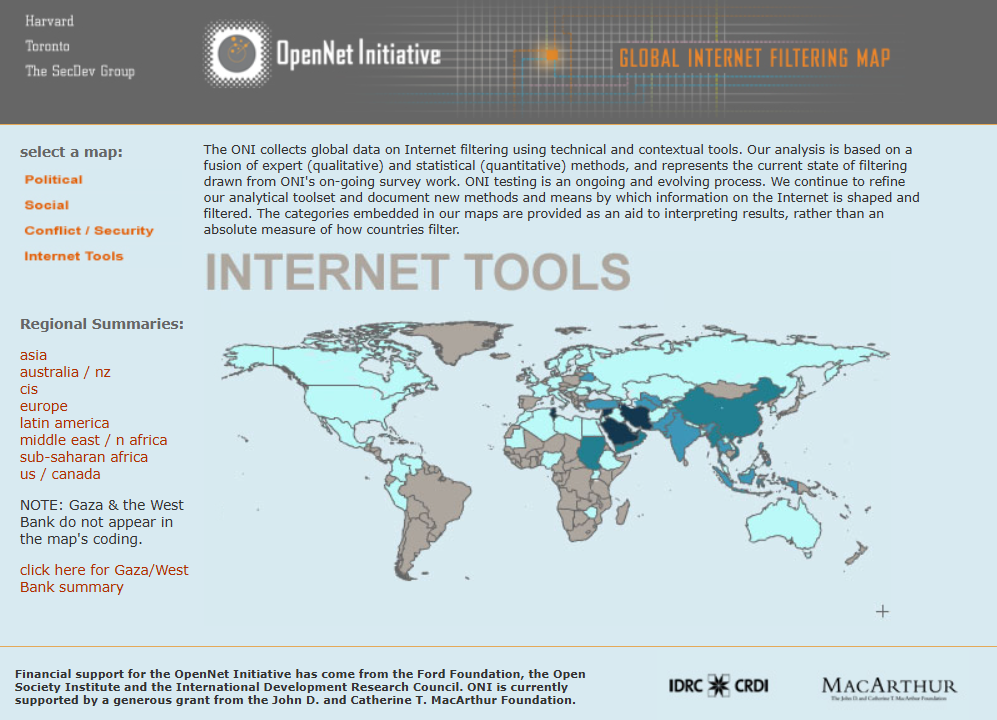
The grey areas offer some level of filtering, the red and yellow offer greater filtering, and the white areas offer no filtering at all of Internet content.
Comments are welcomed below from registered users. You can also leave comments at our Discord server.
If you would like to see more content and articles like this, please support us by clicking the patron link where you will receive free bonus access to courses and more, or simply buying us a cup of coffee!