

In Networking we have always used a Layered Model to represent and apply network functions and protocols and their relationships to one another. Whether you like 7 layers or 4 layers is all wasted argument to me. I am a packet guy, and in the packets the protocols are layered.
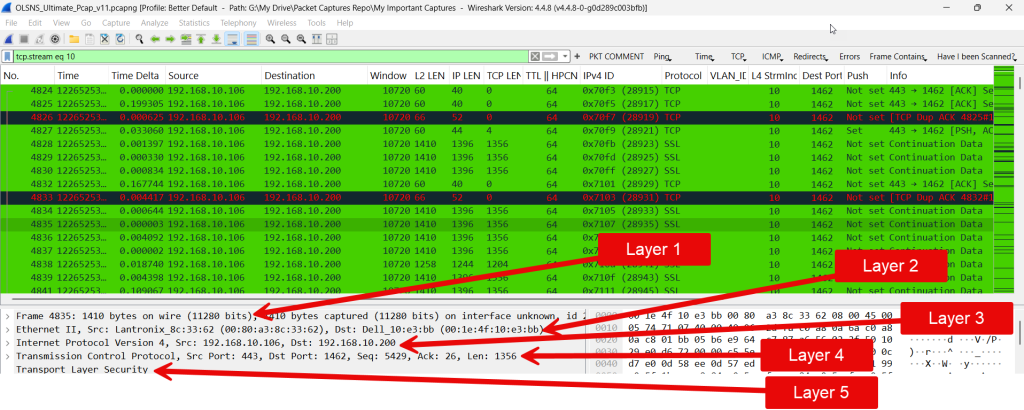
Any manipulation of this either implies an end-to-end awareness – some kind of AI, or some kind of middle box gateway that aids the end systems. Consider the challenge of VPN’s where you have L3 inside L3, or MPLS L2 VPNs where you have L2 Ethernet inside L2.5 MPLS. Maybe I am too old school.
I just got done reading the paper “Revisiting the Internet Layering Principle: AI-Driven Cross-Layer Optimization” (July 2025), and was fascinated by what JP Vasseur, PhD had to say. You can find his paper on LinkedIn post here: https://www.linkedin.com/posts/jp-vasseur-phd_revisiting-internet-layering-july2025-activity-7356374730980872192-5Zka?utm_source=share&utm_medium=member_desktop&rcm=ACoAAAAKH5UBwv3ANxu7CWxWYZd9JNlPNaPP0ck . I encourage everyone to read the paper fully, and hopefully you will agree with my summarization and structured breakdown of the pros and cons of network layering going away or being relaxed in the near future that Dr. Vasseur has opined.
The Pros of Layering Going Away (or Being Softened)
Let’s start with the pros:
1. Improved Performance for Demanding Applications
- AI/ML workloads, real-time video, IoT, and wireless systems often suffer under rigid layering.
- Cross-layer optimization can better meet Service Level Objectives (SLOs) like Quality of Experience (QoE) or Job Completion Time (JCT).
2. Holistic Optimization
- AI can integrate multi-layer telemetry (e.g., PHY layer interference + TCP RTT + user feedback), enabling system-wide visibility and predictive control, leading to smarter, proactive decisions (e.g., rerouting before congestion).
3. Eliminates Redundant Mechanisms
- Today, multiple layers (like link and transport) independently implement reliability features (e.g., retransmissions), often with conflicting timers.
- A unified view helps prevent wasteful retransmissions and latency.
4. Context-Aware Adaptation
- Enables application-aware networking, e.g., a video stream dynamically adjusting quality based on both content type and live network stats.
5. Addresses E2E Encryption Limitations
- Since encrypted traffic hides payload, DPI is ineffective. Cross-layer approaches help maintain service differentiation by augmenting insights using metadata or AI models.
6. Workload-Aware Scheduling
- In data centers, cross-layer models allow job schedulers to optimize based on physical topology and workload traffic patterns, minimizing compute stalls and congestion.
The Cons and Risks of Layering Going Away
Dr. Vasseur captures some great reasons and benefits of Layering in the beginning of the paper. So let’s look at some of the cons of removing the layered concepts:
1. Loss of Modularity
- Layering provides clean separation of concerns, simplifying protocol design, testing, and troubleshooting. Violating it risks tight coupling and complexity creep.
2. Scalability Challenges
- Earlier cross-layer attempts (like RSVP, IntServ) failed due to poor scalability and high control-plane overhead, especially across administrative domains.
3. Standardization and Interoperability Risks
- Layering enabled open standards and multi-vendor interoperability. Cross-layer designs, especially proprietary AI-driven ones, risk reintroducing vendor lock-in.
4. Debugging Complexity
- AI-driven cross-layer optimization is inherently opaque. Diagnosing failures becomes harder when decisions depend on black-box models combining data from many layers.
5. Security and Privacy Concerns
- Holistic telemetry collection requires deep visibility across layers, raising privacy and data security issues (especially with user-level QoE metrics and encrypted data).
6. Legacy System Compatibility
- The global Internet still relies heavily on the modular IP stack. Replacing or bypassing this architecture can lead to compatibility issues and deployment friction.
Balanced View: “Soft Layering” as a Middle Ground
In the end, Dr. Vasseur does not advocate eliminating layering entirely, but proposes “soft layering”—a model that:
- Retains modular APIs and interfaces,
- Introduces cross-layer observability via AI/ML models,
- Enables control loops to augment protocol behavior without breaking abstraction boundaries.
This strategy and introduction of AI preserves many layering benefits while unlocking context-aware optimization for modern high-performance environments.
What are your thoughts? We would love to hear what others have to say.
Comments are welcomed below from registered users. You can also leave comments at our Discord server.
If you would like to see more content and articles like this, please support us by clicking the patron link where you will receive free bonus access to courses and more, or simply buying us a cup of coffee!