

For decades, network automation meant converting a human-designed, generally manual, memorized or scripted procedure into a repeatable process. An engineer decided what should happen, defined the required steps, tested the process, and authorized the “automation” to execute those steps. The automation might provision a VLAN, update a routing policy, restart a failed service, backup or restore, or configure/reconfigure hundreds of devices, but it remained fundamentally deterministic.
Artificial intelligence is changing that relationship.
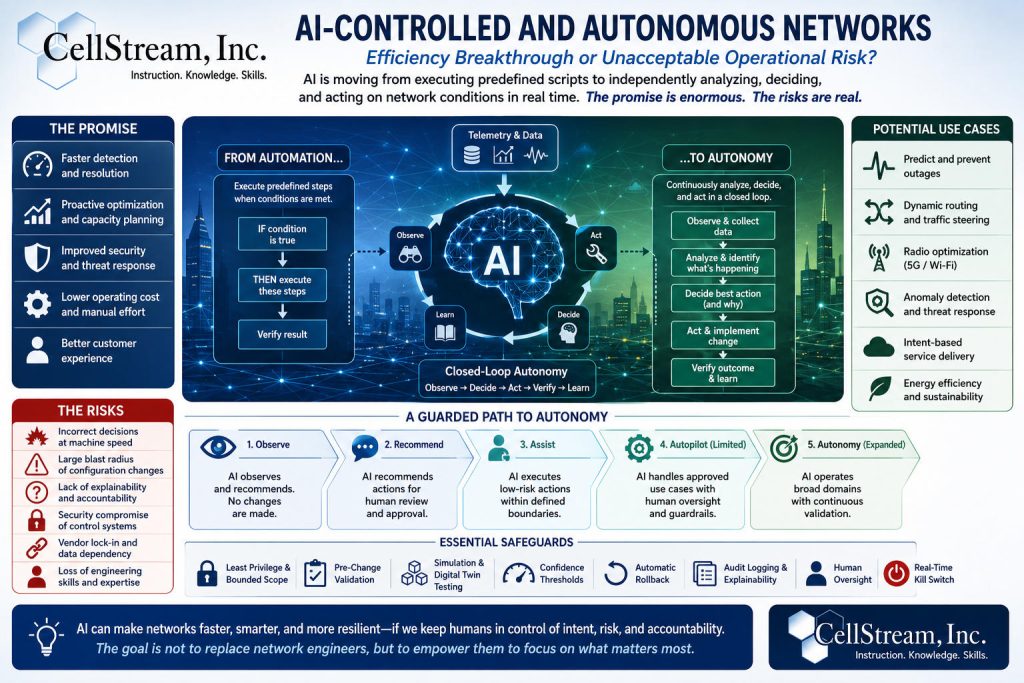
An AI-controlled network may analyze telemetry, identify an emerging problem, determine an appropriate response, implement a configuration change, verify the result, and continue adjusting the network—all with limited, or no human involvement. Instead of merely executing a predefined procedure, the system may decide which procedure should be performed, when it should be performed, and whether it was successful in achieving the intended result.
That transition from automation to autonomy undoubtedly creates enormous potential, but it also raises one of the most consequential debates in networking today:
How much operational authority should we delegate to an artificial intelligence system?
From Automated Networks to Autonomous Networks
Let me clarify: Automation and autonomy are not the same thing.
Traditional automation follows explicit instructions. A “script” (or as Ansible calls it: a playbook) may contain conditional logic, but its possible actions and decision paths are normally defined in advance. If you want to actually learn and experience Ansible: look here. Autonomous systems operate through feedback loops. They observe network conditions, analyze data, select an action, execute it, evaluate the result, and modify their behavior as conditions change.
ETSI’s work on Zero-touch Network and Service Management describes autonomous operation through closed-loop processes that combine monitoring, analytics, decision-making, and execution. Its recent work also examines autonomous agents that can coordinate or chain multiple management services. The technologies involved may include conventional machine learning, anomaly detection, optimization algorithms, intent-based networking, digital twins, generative AI, and increasingly, agentic AI systems capable of planning and performing multistep tasks.
TM Forum uses a maturity model ranging from manually operated networks to progressively higher levels of autonomy. The industry is currently placing considerable emphasis on Level 4, where highly autonomous operation can occur within defined service scenarios or operational domains. A 2026 TM Forum survey of 80 operators reported that 20% expected to achieve Level 4 or higher by 2027, while 81% were targeting that level by 2030.
Let’s be clear, these objectives do not necessarily mean that an entire service-provider network will run without people. Autonomy may first appear in narrowly controlled areas such as radio optimization, energy management, fault remediation, service assurance, capacity planning, or customer-impact analysis.
The Case for Autonomous Networks
The argument in favor of autonomy begins with scale and complexity. Networks generate enormous volumes of telemetry from a variety of sources: routers, switches, wireless systems, cloud platforms, applications, security devices, subscriber systems, and orchestration platforms. A single incident may in fact produce thousands of alarms, many of which describe symptoms rather than identifying the underlying cause. Human operators cannot manually examine every event or continuously optimize every network resource. On the other hand, an AI system can correlate telemetry across multiple domains, recognize patterns that would be difficult for a person to detect, and respond more rapidly than a traditional operations team. Potential applications include:
- Predicting equipment or service failures before customers are affected
- Identifying the probable root cause of a multi-domain outage
- Dynamically allocating bandwidth and computing resources
- Optimizing wireless coverage, capacity, and energy consumption
- Detecting unusual traffic or security behavior
- Automatically rerouting services around congestion or failure
- Validating that a remediation action actually restored service
The GSMA describes agentic AI (Agentic AI refers to AI systems that can set goals, plan, and execute tasks with minimal human intervention by perceiving, reasoning, and acting autonomously in digital or physical environments. It goes beyond generative AI by orchestrating multiple tools and agents to achieve broader objectives across workflows like customer support, supply chains, and healthcare) as a possible foundation for proactive, interoperable systems that can coordinate decisions across telecom networks, services, and operational environments. ETSI similarly describes closed-loop architectures in which simulation and digital-twin results can inform automated decisions and feed subsequent outcomes back into the system.
The operational appeal is clear. A system that detects, diagnoses, and corrects a problem in seconds could reduce outages and outage times (Mean Time to Respond – MTTR and Mean Time to Repair – MTTR), improving customer experience, lowering operating costs, and freeing engineers from extensive and repetitive alarm handling.
The Risk of Making the Wrong Decision Faster
Automation allows organizations to perform correct actions consistently and at scale. Unfortunately, it can also perform an incorrect action consistently and at scale. This is the central risk of autonomous networking:
A bad decision may propagate much faster than a human operations team can recognize and stop it.
Similarly, an AI system can make a poor recommendation because its telemetry is incomplete, delayed, misleading, or corrupted. It may encounter a network condition that was not represented in its training or testing data. It may optimize one metric while damaging another—for example, reducing energy consumption while degrading coverage, or lowering latency for one service while starving another.
Generative and agentic systems introduce additional concerns. A system may produce an incorrect explanation, invent a command or configuration parameter, misinterpret an operator’s intent, or construct a technically valid change that is inappropriate for the production environment.
The problem is not simply that AI systems can be wrong. Human engineers also make mistakes. The difference is speed, reach, and authority. A person may incorrectly configure one router. An autonomous controller could push a flawed policy across an entire network domain before the first customer complaint is received. This potential impact is often called the automation blast radius.
Who Is Accountable When the Network Makes the Decision?
Autonomous operation complicates accountability. Suppose an AI system changes a routing policy and causes a regional outage. Who is responsible?
Is it the engineer who approved the system? The operator that deployed it? The software vendor that developed the model? The organization that supplied the training data? The manager who authorized autonomous operation? Or the AI agent that selected the action? The final option is not meaningful from a governance perspective. An AI system cannot accept professional, financial, or legal responsibility. Accountability remains with people and organizations, even when those people cannot fully explain why the system made a particular decision.
NIST’s AI Risk Management Framework emphasizes that AI risks should be governed throughout the system lifecycle rather than addressed only after deployment. Its framework organizes risk management around four functions: Govern, Map, Measure, and Manage. It also identifies organizational policies, documented responsibilities, transparency, and accountability as fundamental controls.
For network operators, this means every autonomous action should be attributable, reviewable, and reversible. A production system should record:
- What information the AI evaluated
- What decision it made
- Why the action was selected
- Which devices, services, or customers could be affected
- Whether a human approved the action
- What changes were actually executed
- Whether the intended result was achieved
- How the network can be restored to its previous state
Without this evidence, autonomy can become operationally unaccountable.
Security, Privacy, and Vendor Control
AI-controlled networks require broad access to telemetry, configurations, topology information, customer-impact data, performance history, and operational procedures. That information is extremely valuable—and extremely sensitive. If an attacker compromises an autonomous management system, the attacker may gain more than visibility. The system may provide a trusted path for executing changes across the network. An AI agent with configuration privileges therefore becomes a high-value target whose identity, credentials, tools, and permitted actions must be tightly controlled.
Vendor dependence is another concern. An operator may become reliant on proprietary models, telemetry formats, decision engines, or cloud-hosted AI platforms. If the reasoning process cannot be independently examined or transferred to another system, the operator may lose practical control over an important portion of its own network operations.
Open interfaces and interoperable architectures are therefore essential. ETSI’s Zero-touch work specifically considers how autonomous capabilities can be applied through open and interoperable mechanisms rather than isolated vendor-specific systems.
Will Autonomy Eliminate Network Engineering Jobs?
Autonomous networking will change network-engineering work, but it is unlikely to eliminate the need for network expertise. Someone must define operational intent, establish acceptable risk, validate proposed actions, investigate unexpected behavior, maintain telemetry quality, secure the control environment, and determine whether the AI’s conclusions are technically sound. The more authority an AI system receives, the more important these responsibilities become.
A serious workforce risk does exist, however. If entry-level personnel no longer perform routine troubleshooting and configuration work, they may lose the experiences through which senior engineers traditionally developed. An organization could eventually become dependent on systems that its own staff no longer fully understand. Autonomous networking will eliminate some job categories, particularly positions built primarily around repetitive and predictable tasks. It will also create new roles requiring deeper expertise in automation, analytics, cybersecurity, AI governance, system validation, and cross-domain network engineering. The central workforce challenge is not preventing technological change; it is ensuring that today’s technicians and engineers have a practical path into tomorrow’s higher-skilled positions.
The goal should therefore be to remove repetitive effort without removing technical understanding. There needs to be a solid and deep understanding of how the AI systems actually work. So engineers must be trained not only to operate networks, but also to supervise, test, audit, and challenge autonomous systems.
A Practical Path Toward Guarded Autonomy
The debate should not be reduced to a choice between fully manual networks and unrestricted AI control. A much safer approach is graduated autonomy. An organization might initially run an AI system in observation or shadow mode, allowing it to analyze events and recommend actions without making changes. Its recommendations can then be compared with actual engineering decisions. As confidence grows, the system might be permitted to execute low-risk actions within a carefully defined domain. Higher-risk changes would continue to require human approval. Appropriate safeguards include:
- Strictly bounded permissions
- Pre-change validation
- Digital-twin or laboratory testing
- Confidence thresholds
- Maintenance-window restrictions
- Independent policy and security checks
- Automatic rollback
- Rate limits on configuration changes
- Real-time kill switches
- Complete audit logging
- Periodic human review
No AI system should receive unrestricted production privileges simply because it performed well in a demonstration. Autonomy must be earned through measured performance, controlled deployment, and continuing validation.
Finding the Appropriate Balance
AI-controlled networks are not merely a futuristic concept. Standards organizations, operators, and vendors are actively developing architectures for closed-loop, intent-driven, and agent-based operations. The potential benefits are substantial, particularly as networks become too complex for purely manual management.
However, a network that can act independently can also fail independently. The most important question is not whether AI will participate in network operations. It already does. The real question is which decisions it should be permitted to make without human approval.
The strongest model is neither complete human control nor complete machine autonomy. It is a governed partnership in which AI supplies speed, correlation, and scale while experienced professionals retain responsibility for policy, risk, validation, and accountability.
The autonomous network may be able to configure itself, optimize itself, and heal itself. But it must never become a network that no one can explain, control, or safely stop. What are your thoughts?
If you would like to help support the continued development of independent networking, broadband, Wi-Fi, VoIP, and packet analysis content, please consider joining our Patreon community where you will gain access to exclusive technical resources, downloadable labs and PCAPs, bonus course content, troubleshooting guides, and additional member-only material. Comments and technical discussion are always welcomed at our Patreon community or on our Discord server. You can also support our work by simply buying us a coffee — every contribution helps us continue creating practical, real-world network science education for professionals and enthusiasts alike.