

Moore’s Law is an observation made by Gordon E. Moore, co-founder of Intel, in 1965. He noted that:
The number of transistors on a microchip doubles approximately every two years, while the cost of computers is halved.
This effectively meant exponential growth in computing power and a decrease in relative cost over time.
- Origin: First published in a 1965 paper by Moore in Electronics Magazine.
- Initial Prediction: Moore originally stated that the number of transistors on integrated circuits would double every year.
- Revision: In 1975, he revised the prediction to every two years, which became the commonly cited version.
- Impact: It became a guiding principle for the semiconductor industry, influencing R&D, production roadmaps, and expectations for performance improvements.
So where do we stand today – 50 years down the technology development path?
The answer is yes!
Thanks to the great folks at OurWorldinData.org we have a very accurate picture at least of the number of transistors:
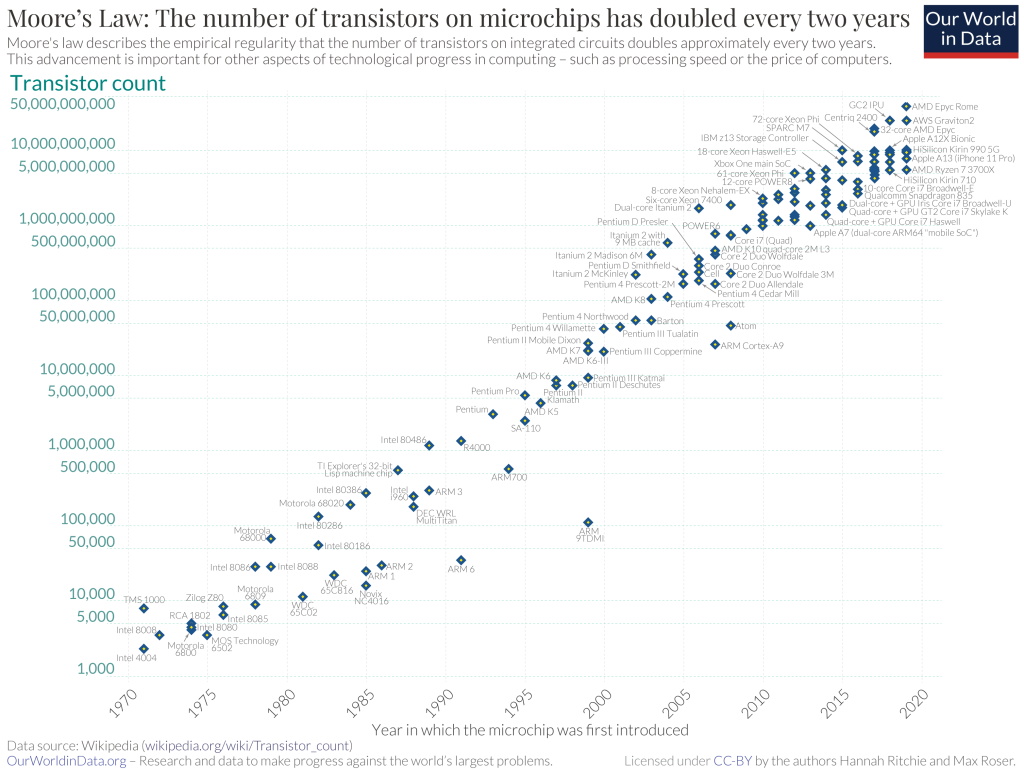
Don’t let anyone tell you that Moore’s Law was not predictive and accurate.
If you would like to help support the continued development of independent networking, broadband, Wi-Fi, VoIP, and packet analysis content, please consider joining our Patreon community where you will gain access to exclusive technical resources, downloadable labs and PCAPs, bonus course content, troubleshooting guides, and additional member-only material. Comments and technical discussion are always welcomed at our Patreon community or on our Discord server. You can also support our work by simply buying us a coffee — every contribution helps us continue creating practical, real-world network science education for professionals and enthusiasts alike.