

Adaptive Bitrate Streaming (ABR) is a video delivery method that dynamically adjusts the quality of a stream in real time based on three things: network conditions, device capability, and player performance. Instead of delivering a single fixed-quality, and therefore fixed transfer rate video, ABR continuously selects the most appropriate bitrate to maintain smooth playback while maximizing visual quality.
Here is a summary/cheat sheet on ABR, but we will dive in below:
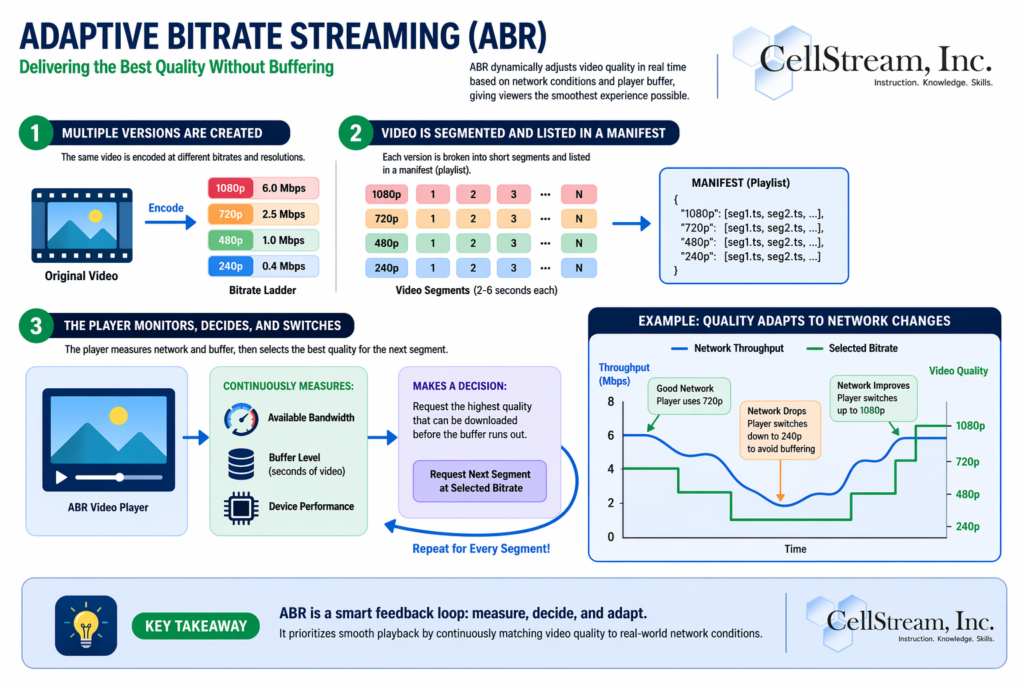
How Adaptive Bitrate Streaming Works
At its core, ABR is built on three foundational mechanisms:
1. Multiple Encodes (think of this as a Bitrate Ladder)
A single video is encoded into multiple versions at different bitrates and resolutions. For example:
- 240p @ 400 kbps
- 480p @ 1 Mbps
- 720p @ 2.5 Mbps
- 1080p @ 5–8 Mbps
This collection of encodes is commonly referred to as a bitrate ladder.
2. Segmented Video Delivery
Each encoded version of a given video is divided into small chunks or segments, typically 2–10 seconds in duration. These segments are listed in a manifest (playlist) file that the player uses to request content.
3. Intelligent Client-Side Decision Making
The video player on the client side continuously evaluates:
- Available bandwidth (throughput estimation)
- Buffer occupancy (seconds of video preloaded)
- Device CPU/GPU capabilities
Based on these measurement inputs, the player dynamically selects the highest bitrate it can sustain without causing buffering.
Common ABR Protocols
Modern streaming relies on HTTP-based delivery, which makes it scalable and CDN-friendly. The most widely used protocols include:
- HTTP Live Streaming (HLS)
- Dynamic Adaptive Streaming over HTTP (MPEG-DASH)
- Smooth Streaming (legacy)
All of these use standard HTTP transport, enabling efficient delivery over existing Internet infrastructure.
Why ABR Is Necessary
Real-world networks are inherently bursty, lossy (Ethernet and Wi-Fi) and therefore somewhat unstable. In both broadband access and Wi-Fi LAN environments, conditions change constantly due to:
- RF interference and signal variability
- Network congestion
- Latency and jitter fluctuations
- Packet loss and retransmissions
A fixed-bitrate stream would either:
- Buffer constantly (if bitrate is too high), or
- Waste available capacity (if bitrate is too low)
ABR solves this by continuously adapting to current network conditions, prioritizing an uninterrupted playback experience.
What ABR Looks Like in Packet Analysis
As my readers know, I am and have been a huge packet capture fan as the packets don’t make up stories. They are plain fact. Furthermore, packet analysis is about noticing patterns and pattern changes. So let’s talk about looking at ABR in packet analysis. When analyzing ABR traffic in Wireshark or similar tools, you will observe (assuming the traffic is unencrypted):
- Repeated HTTP/HTTPS GET requests for media segments
- Variable segment sizes corresponding to bitrate changes
- Burst download patterns (download → idle → download)
- DNS/CDN redirection behavior
- Increasing use of UDP flows when QUIC/HTTP/3 is in play
These patterns provide a direct way to correlate network behavior with user experience.
You could create a packet capture for yourself by simply following these steps:
- Start capture
- Stream video (YouTube or similar)
- Force bitrate changes in one of the following ways:
- Throttle bandwidth (Wi-Fi interference or traffic shaping)
- Move closer/farther from AP to cause Wi-Fi to change speeds
- Use browser dev tools to limit bandwidth
- Stop capture
If you would like to use a synthetic ABR packet capture and Wireshark, join my Patreon where you can access this and many other lab exercises.
Advantages of ABR
- Minimizes buffering and playback interruptions
- Adapts to changing network conditions in real time
- Scales efficiently using CDNs
- Works across a wide range of devices and access technologies
Tradeoffs and Limitations
- Visible quality shifts (resolution/bitrate changes)
- Initial startup delay while buffering begins
- Potential inefficiencies under TCP congestion control
- Bandwidth estimation inaccuracies, especially in Wi-Fi environments
Real-World Usage
ABR is the standard for modern streaming platforms such as:
- Netflix
- YouTube
- Amazon Prime Video
Each platform implements its own optimization logic, but the underlying ABR concept remains consistent.
Final Perspective
Adaptive bitrate streaming is best understood as a feedback control system at the application layer. The player continuously measures network performance and adjusts its consumption rate accordingly. This makes ABR one of the most practical and widely deployed examples of real-time control systems operating across the Internet.
If you would like to help support the continued development of independent networking, broadband, Wi-Fi, VoIP, and packet analysis content, please consider joining our Patreon community where you will gain access to exclusive technical resources, downloadable labs and PCAPs, bonus course content, troubleshooting guides, and additional member-only material. Comments and technical discussion are always welcomed at our Patreon community or on our Discord server. You can also support our work by simply buying us a coffee — every contribution helps us continue creating practical, real-world network science education for professionals and enthusiasts alike.