

Back in 2018 (I think) I was becoming increasingly aware of the QUIC protocol in my and other’s packet captures and I immediately dug in and wrote about it.
As of recent data (now Feb 2025), QUIC (Quick UDP Internet Connections) is experiencing significant adoption across the internet. Websites have implemented QUIC, with HTTP/3—built upon QUIC—being utilized by around 35–40% of websites that now advertise HTTP/3 capability. But actual traffic carried over QUIC can be much higher on major platforms because large providers dominate Internet traffic volume. Google, Meta/Facebook, YouTube, Gmail, Instagram, TikTok, and major CDNs generate enormous QUIC traffic shares.
In terms of traffic volume, major platforms have reported substantial usage of QUIC. For instance, by October 2020, Meta (formerly Facebook) indicated that over 75% of its internet traffic was transmitted using QUIC and HTTP/3. Engineering at Meta
CDN adoption was the real tipping point. Once providers like:
enabled HTTP/3 broadly, adoption accelerated rapidly because millions of websites inherited QUIC support automatically.
Similarly, as of June 2023, approximately 40% of Google’s Chrome browser traffic was utilizing QUIC. ipoque
Overall, QUIC’s share of global internet traffic has been on the rise. Between May 2022 and May 2023, HTTP/3 traffic increased from 37% to 45%, before stabilizing around 40% in mid-September 2023. The Cloudflare Blog
Mobile networks strongly favored QUIC. QUIC performs especially well on:
- lossy wireless links
- mobile roaming
- NAT-heavy environments
- high-latency paths
This helped drive massive deployment in mobile applications and streaming/video services.
Technically, QUIC adoption is one of the fastest transport-layer shifts the Internet has seen in decades because:
- it replaced TCP behavior without replacing IP
- it runs over UDP (easier middlebox traversal/deployment)
- it integrated TLS 1.3 directly
- browsers and CDNs controlled both endpoints of deployment
That combination allowed QUIC to bypass many of the deployment problems that slowed IPv6, SCTP, or other transport innovations.
This growth reflects QUIC’s expanding role in enhancing web performance and security.
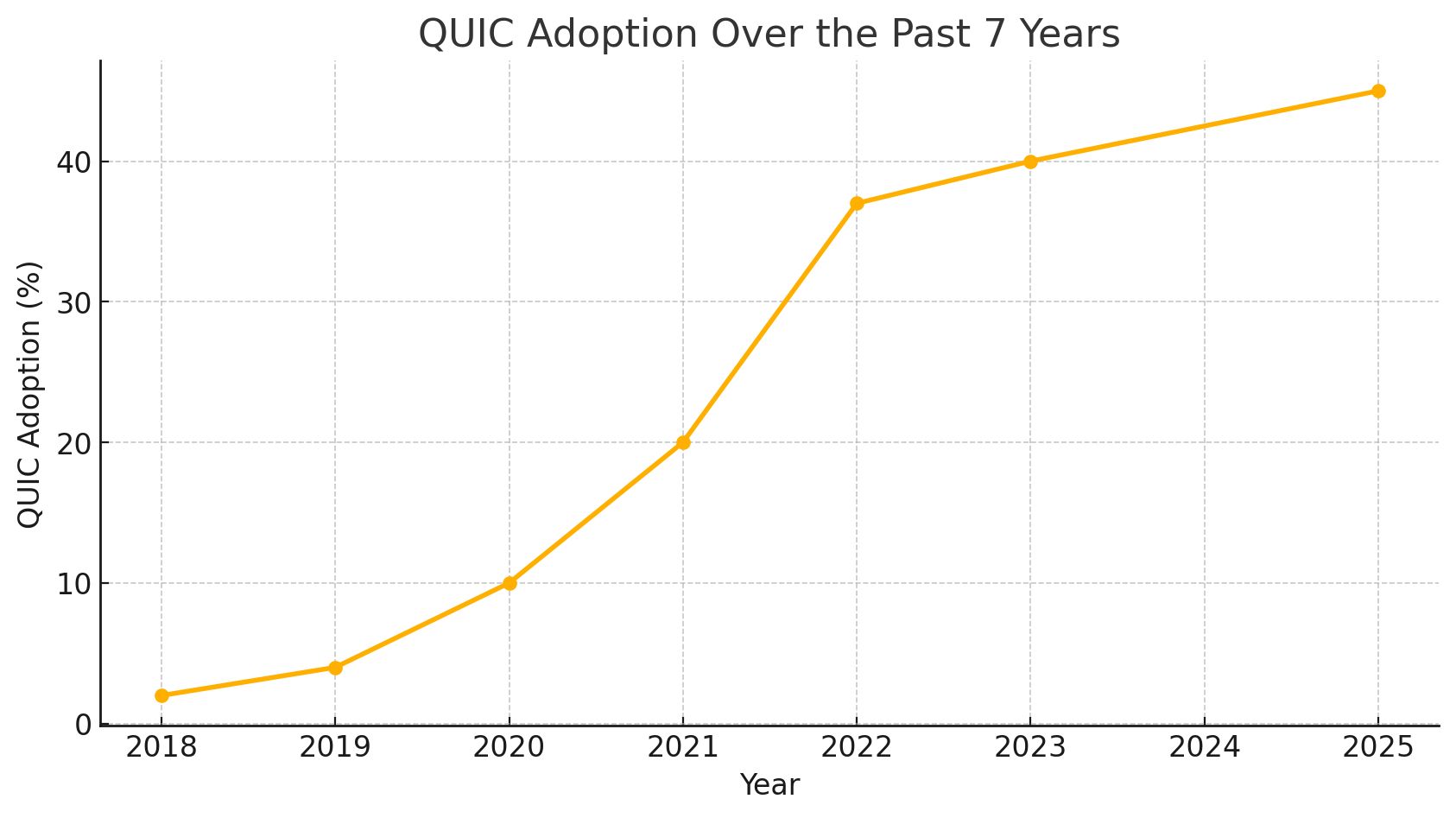
Here’s a graph depicting the levels of QUIC adoption over the past seven years. It shows a steady increase, with significant growth between 2020 and 2025 as more websites and platforms implemented QUIC for improved web performance and security.
If you would like to help support the continued development of independent networking, broadband, Wi-Fi, VoIP, and packet analysis content, please consider joining our Patreon community where you will gain access to exclusive technical resources, downloadable labs and PCAPs, bonus course content, troubleshooting guides, and additional member-only material. Comments and technical discussion are always welcomed at our Patreon community or on our Discord server. You can also support our work by simply buying us a coffee — every contribution helps us continue creating practical, real-world network science education for professionals and enthusiasts alike.