

The phrase net neutrality is often summarized as the principle that all Internet traffic should be treated equally. That definition is appealing, but technically lacking and incomplete. Modern networks do not—and often should not—treat every packet identically. The subject itself is not new around here and you can view my other posts on the subject here.
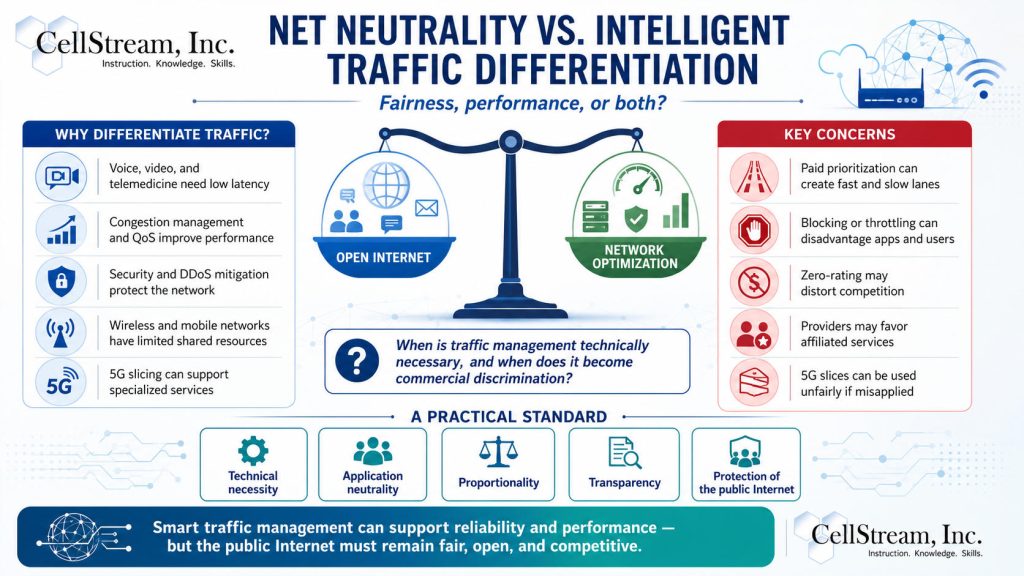
A voice call has different performance requirements from an email download. A telemedicine session may be more sensitive to delay and packet loss than a software update. Emergency communications may need access to network resources during congestion. Interactive gaming, industrial control, video streaming, cloud backups, and ordinary web browsing all place different demands on the network.
Not to get into the weeds too early here, but let’s clarify the Internet operational behavior for a second. Traffic is transmitted in packets. Most traffic is bursty, so you do not consume 100% or your bandwidth 100% of the time. Neither does anyone else. So the service provider does not need to provide 10,000 Gigabits of bandwidth for 10,000 users. So they don’t. This is not new news. There is somewhat of a management game played of multiplexing all their users onto a shared “pipe” and then monitoring that pipe for how full it is. If you can keep the pipe around 80% full, then there is plenty of bandwidth for everyone and there is no need to implement any Quality of Service policies.
With that notion in mind, if the pipe if too full, network operators/Service Providers may need to use traffic classification, queuing, scheduling, congestion management, Quality of Service, traffic engineering, and increasingly 5G network slicing to deliver acceptable performance. These mechanisms may make networks more reliable and efficient. Or does it?
The controversy begins when technically justified traffic management becomes commercially motivated discrimination.
When does intelligent traffic differentiation improve the network, and when does it allow a provider to decide which applications, businesses, or users receive acceptable service?
What Net Neutrality Actually Means
Net neutrality does not necessarily require every packet to receive identical treatment. A more practical definition is that broadband providers should not unfairly block, throttle, degrade, or prioritize lawful Internet traffic based on the content, application, service, sender, recipient, or commercial relationship involved.
Under this interpretation, an Internet provider may still perform reasonable network management. It can mitigate congestion, defend against attacks, block traffic requested by the customer, manage scarce wireless resources, and protect the stability of the network.
The difficult part is determining whether a practice is genuinely technical or primarily commercial.
The FCC’s 2024 Open Internet Order attempted to draw this line by treating network-management practices as reasonable when they were primarily motivated by a technical purpose and appropriately tailored to the network’s architecture and technology. The order distinguished those practices from paid or affiliated prioritization, which the FCC said did not have a primarily technical network-management purpose. The order was later set aside by the Sixth Circuit, but its reasoning illustrates the central policy distinction between engineering and commercial discrimination.
A congestion-control policy that temporarily limits every large software download during an overloaded period may be legitimate network management. Slowing a particular streaming company because it competes with the provider’s own video service would be a very different matter.
Why Networks Differentiate Traffic
Traffic differentiation is fundamental to network engineering. Routers and switches have finite buffers, interfaces have finite capacity, and wireless networks must share limited spectrum among many devices. When demand exceeds available resources, the network must decide which packet to transmit next, who goes first, and which packet may have to wait or be discarded.
Quality of Service mechanisms allow operators to classify traffic and assign it to queues with different scheduling, delay, loss, or bandwidth characteristics. Real-time voice packets might receive low-latency treatment, while a background file transfer continues through a best-effort queue. This does not necessarily prevent the file transfer from completing; it simply recognizes that the two applications respond differently to delay.
Network differentiation can support:
- Voice, video conferencing and other real-time applications
- Public-safety and emergency communications
- Telemedicine and remote-control systems
- Protection against denial-of-service attacks
- Congestion control on oversubscribed links
- Customer-selected service classes
- Industrial, automotive and Internet of Things applications
- Wireless resource and mobility management
The technical case becomes even stronger in mobile networks. Radio capacity changes with signal quality, interference, movement, device density, spectrum availability, and environmental conditions. A wireless operator cannot manage those conditions by pretending that every flow has identical requirements.
The goal of intelligent traffic differentiation is therefore not automatically to create winners and losers. It can be to use limited network resources in a way that preserves the performance of the greatest number of services and customers.
The Paid-Prioritization Concern
Net-neutrality advocates are particularly concerned about paid prioritization: arrangements in which an application or content provider pays a broadband provider to receive preferential delivery to the provider’s subscribers. Supporters of strict net neutrality rules argue that paid prioritization could create Internet fast and slow lanes. Large companies could afford premium delivery, while startups, nonprofit organizations, educational institutions, independent creators, and small businesses might remain in a lower-performing class.
The concern extends beyond intentionally slowing traffic. A broadband provider could allow the ordinary Internet service to become congested while reserving increasing amounts of capacity for premium services. Customers might technically retain access to every lawful application, but the practical quality of that access could depend on whether the application provider had paid for preferred treatment.
The FCC’s vacated 2024 order concluded that the potential competitive and consumer harms of paid prioritization outweighed its possible benefits. It also distinguished prioritization from content-delivery-network arrangements that place copies of content closer to users. Local caching can improve performance by shortening the delivery path without necessarily giving packets discriminatory treatment inside the access network. That distinction matters. A service may perform better because it invested in servers, peering, caching, efficient protocols, or a better network architecture. Net neutrality does not have to mean preventing companies from engineering better performance. The dispute concerns whether the broadband access provider should sell control over the treatment of traffic as it travels to the customer.
Zero-Rating and Usage-Based Policies
Another disputed practice is zero-rating, in which traffic from selected applications does not count against a customer’s data allowance. From the consumer’s perspective, free or unmetered access to a popular application can appear beneficial. It may allow customers to use messaging, educational, video, or social-media services without consuming their monthly allowance. The competitive concern is that zero-rating can influence which services customers choose. A new video platform whose traffic counts against a data cap may have difficulty competing with an established platform whose traffic is exempt. The provider does not need to block or slow the newcomer; the billing policy itself changes user behavior.
This demonstrates why the debate extends beyond packet scheduling. Traffic differentiation can occur through speed, latency, loss, data allowances, pricing, service bundles, application-specific plans, or access to specialized network resources.
The 5G Network-Slicing Challenge
Cellular 5G makes the debate more complicated.
Network slicing allows a mobile operator to create logical network partitions with different resources, isolation, topology, configuration, and performance characteristics. A slice might be designed for massive numbers of low-bandwidth sensors, highly reliable industrial communications, low-latency applications, or ordinary consumer broadband. 3GPP identifies network slicing as a major 5G capability intended to support services with differing requirements.
Network slicing is a virtualization technique—most commonly associated with 5G—that allows a single physical network to be divided into multiple logical networks, or “slices,” each configured for a specific service requirement. One slice might prioritize very low latency for industrial control, another might support massive numbers of IoT devices, and another might provide ordinary mobile broadband. Each slice can have its own performance, security, capacity, and reliability characteristics while sharing the same underlying radio, transport, and core infrastructure.
From an engineering perspective, network slicing is a powerful and legitimate technology. A connected factory, emergency-response organization, transportation system, or healthcare application may need performance guarantees that the public best-effort Internet cannot provide. From a neutrality perspective, a network slice can resemble a sophisticated fast lane. If selected commercial applications are placed in privileged slices while competing applications remain on a congested general-purpose service, the technical mechanism may produce the same practical result as paid prioritization. The technology itself is neither neutral nor discriminatory. Its impact depends on how it is used.
The FCC’s 2024 proceeding captured both sides of the disagreement. Some participants warned that slices could become a means of evading open-Internet protections, while mobile-network interests argued that broad restrictions could interfere with valuable 5G innovation. The FCC declined to classify every use of network slicing categorically and instead proposed evaluating particular implementations and their effect on ordinary broadband capacity. Those rules did not survive the subsequent court decision, but the underlying technical question remains unresolved.
The Argument Against Strict Regulation
Opponents of broad net-neutrality regulation argue that rigid rules can discourage innovation and prevent providers from offering useful services. A network operator may need to guarantee performance for a remote surgical system, autonomous-vehicle application, business customer, emergency service, or industrial facility. Developing and maintaining these capabilities requires investment. Providers argue that they should be able to charge customers for differentiated service levels, just as cloud platforms, private networks, and enterprise carriers already do.
They also contend that broadband markets are dynamic and that prescriptive rules may become obsolete as technologies evolve. A regulatory definition written for fixed broadband and traditional TCP applications may not map cleanly onto virtualized 5G cores, edge computing, satellite broadband, private wireless networks, or future 6G services.
There is also a legitimate question of customer choice. A business may willingly purchase a managed connection with guaranteed latency. A consumer may prefer a lower-cost package optimized for a limited group of applications. Prohibiting every form of differentiation could eliminate service options that some customers value.
The Argument for Strong Protections
Supporters of net-neutrality rules respond that broadband providers occupy a uniquely powerful position. They control the final access path between users and the Internet services they want to reach. In many locations, customers have only one or two realistic high-speed broadband choices. Changing providers may involve installation costs, contracts, equipment replacement, limited coverage, or no viable alternative at all. Competitive-market discipline may therefore be insufficient to prevent discriminatory practices. A provider may also operate services that compete with companies whose traffic crosses its network. A company that sells broadband, mobile service, video, advertising, cloud products, or entertainment content may have both the technical ability and the financial incentive to favor affiliated offerings.
The neutrality argument is ultimately about preserving the Internet as a platform on which a new service can reach users without first negotiating favorable carriage terms with every access provider.
The Current U.S. Legal Landscape
The United States does not currently have the nationwide federal net-neutrality framework adopted by the FCC in 2024.
In January 2025, the Sixth Circuit Court of Appeals set aside the order. The court held that broadband Internet access is an “information service,” rather than a Title II telecommunications service, and that the FCC lacked statutory authority to impose the order’s net-neutrality requirements through that classification.
The result is a fragmented policy environment. California’s Internet Consumer Protection and Net Neutrality Act prohibits practices including blocking, throttling, certain paid prioritization, and specified forms of application-specific discrimination. The law was enacted as SB 822 and remains an important example of state-level regulation.
Federal transparency requirements also continue to play a role. Broadband consumer labels require providers to disclose information such as prices, speeds, data allowances, and other service terms, although transparency alone does not determine whether a traffic-management practice is permissible.
The continuing changes between federal orders, court decisions, and state requirements demonstrate that the dispute is far from settled.
A Practical Standard for Intelligent Differentiation
The strongest policy may not require networks to treat every packet identically. Instead, it could require traffic differentiation to satisfy several tests:
- Technical necessity: Is the practice intended to solve a genuine performance, reliability, congestion, safety, or security problem?
- Application neutrality: Are comparable applications treated comparably, regardless of ownership or commercial affiliation?
- Proportionality: Is the differentiation limited to what is necessary to achieve the technical objective?
- Transparency: Can customers and application providers understand that the practice exists and how it may affect them?
- Protection of the public Internet: Does the differentiated service leave sufficient capacity and performance for ordinary broadband access?
- User control: Where practical, is the differentiation selected by the customer rather than imposed without meaningful choice?
These principles would allow legitimate QoS, network slicing, security controls, and specialized services while making it more difficult to disguise commercial favoritism as network engineering.
Finding the Appropriate Balance
The Internet cannot operate effectively without traffic management. Congestion must be controlled, attacks must be mitigated, wireless resources must be allocated, and delay-sensitive applications sometimes require differentiated treatment. At the same time, the network provider should not become an unchecked gatekeeper that decides which ideas, applications, companies, or voices receive usable access to customers.
The central issue is therefore not whether networks should differentiate traffic. They already do, and they must. The question is why the traffic is being differentiated, who benefits, who is disadvantaged, and whether the ordinary Internet remains an open and competitive platform.
Intelligent traffic differentiation and net neutrality do not have to be opposing absolutes. The appropriate goal is a network that can recognize legitimate technical requirements without converting that intelligence into hidden commercial discrimination. The packets do not all need identical treatment. The people and services depending on those packets do need fair treatment.
What are your thoughts?
If you would like to help support the continued development of independent networking, broadband, Wi-Fi, VoIP, and packet analysis content, please consider joining our Patreon community where you will gain access to exclusive technical resources, downloadable labs and PCAPs, bonus course content, troubleshooting guides, and additional member-only material. Comments and technical discussion are always welcomed at our Patreon community or on our Discord server. You can also support our work by simply buying us a coffee — every contribution helps us continue creating practical, real-world network science education for professionals and enthusiasts alike.