
- Version
- Download 2228
- File Size 24.59 KB
- File Count 1
- Create Date May 29, 2015
- Last Updated October 13, 2026
SIP Response Messages Cheat Sheet
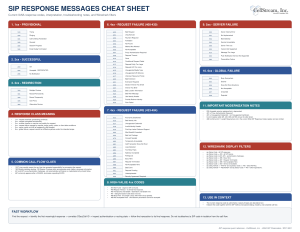 This updated SIP Response Messages Cheat Sheet is designed as a quick-reference guide for anyone analyzing SIP call flows, troubleshooting VoIP signaling, or studying how SIP transactions succeed or fail. The original sheet organized the major SIP response classes from 1xx Provisional through 6xx Global Failure, with common codes such as
100 Trying, 180 Ringing, 200 OK, 404 Not Found, 486 Busy Here, 503 Service Unavailable, and 600 Busy Everywhere. SIP Response Messages Cheat She… SIP Response Messages Cheat She… The updated version keeps that familiar structure but adds current response codes, corrections, and practical troubleshooting guidance.
The reason this cheat sheet is useful is that SIP response codes are central to understanding what happened during a call, registration, subscription, or other transaction. Seeing a 4xx, 5xx, or 6xx response immediately narrows the problem space, but the individual code tells you much more. A 401 or 407 is usually part of an authentication exchange, 480 means the destination is temporarily unavailable, 486 means a particular target is busy, while 600 indicates a broader global failure condition. Having those meanings available at a glance makes call-flow analysis much faster.
How to use the cheat sheet: first identify the SIP request that started the transaction, then find the first meaningful response and follow the exchange to its final response. Use the response class to determine the general category of the event, then use the specific code to understand the condition. Correlate the response with the SIP method, CSeq, Call-ID, From/To information, and the surrounding signaling before deciding what actually failed. A response code should always be interpreted in the context of the complete call flow.
The updated sheet also includes several important content notes. It distinguishes provisional, successful, redirection, request-failure, server-failure, and global-failure responses, highlights commonly encountered troubleshooting codes, and adds modern registered responses that were not present in the older version. It also calls out cases where older terminology or code listings have changed, helping prevent outdated references from creeping into troubleshooting or training material.
The cheat sheet includes practical Wireshark display filters so you can move directly from a response code to packet analysis. Use them to isolate all SIP failures, authentication challenges, failed INVITEs, failed REGISTER transactions, or specific responses such as 486, 487, 488, or 503. It is a useful reference for VoIP troubleshooting, SIP training, Wireshark labs, NOC support, certification study, and call-flow analysis, especially when you need to move quickly from “the call failed” to the exact SIP response that explains why.
Did you find this useful? Would you change or modify this file in any way? If you would like to help support the continued development of independent networking, broadband, Wi-Fi, VoIP, and packet analysis content, please consider joining our Patreon community where you will gain access to exclusive technical resources, downloadable labs and PCAPs, bonus course content, troubleshooting guides, and additional member-only material. You can also leave comments at our Discord server. You can also support our work by simply buying us a coffee — every contribution helps us continue creating practical, real-world network science education for professionals and enthusiasts alike.