
- Version
- Download 5698
- File Size 241.49 KB
- File Count 1
- Create Date October 1, 2013
- Last Updated October 12, 2026
802.11 WLAN Wi-Fi Cheat Sheet
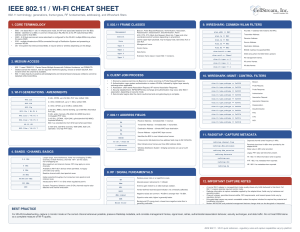 This updated CellStream IEEE 802.11 / Wi-Fi Cheat Sheet is designed as a practical first-level reference for anyone working with wireless LANs. It brings together the concepts you are most likely to need during study, design, troubleshooting, or packet analysis, including 802.11 terminology, Wi-Fi generations, 2.4/5/6 GHz operation, channel widths, DFS, frame classes, client association, address fields, RF signal concepts, and the differences between management, control, and data frames.
The sheet also includes a focused set of Wireshark display filters for wireless analysis, covering BSSID, transmitter and receiver addresses, SSIDs, management frames, control frames, Radiotap information, and common 802.11 subtypes. Because useful WLAN packet analysis often depends on capturing in monitor mode and preserving radio metadata, the cheat sheet also highlights important capture considerations such as Radiotap, RSSI, signal levels, channel selection, encryption, and adapter capabilities.
If you work with Wi-Fi only occasionally, this gives you a compact reference without having to remember every field, frame type, or filter. If you work with WLANs regularly, it is useful to keep nearby during troubleshooting and packet analysis when you need to quickly identify what a frame means or build the right Wireshark filter.
Capturing 802.11 traffic correctly can be just as important as analyzing it. You can find our articles on wireless monitor-mode capture here: Monitor Mode Articles.
You can also check out our Wireshark Profile Repository, our Wireshark videos on YouTube, and our Wireshark courses on Udemy.
Did you find this useful? Would you change or modify this file in any way? If you would like to help support the continued development of independent networking, broadband, Wi-Fi, VoIP, and packet analysis content, please consider joining our Patreon community where you will gain access to exclusive technical resources, downloadable labs and PCAPs, bonus course content, troubleshooting guides, and additional member-only material. You can also leave comments at our Discord server. You can also support our work by simply buying us a coffee — every contribution helps us continue creating practical, real-world network science education for professionals and enthusiasts alike.