
- Version
- Download 6201
- File Size 221.85 KB
- File Count 1
- Create Date October 2, 2013
- Last Updated October 12, 2026
IPv4 Cheat Sheet
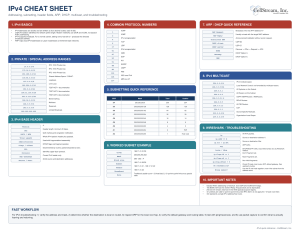 This updated IPv4 Cheat Sheet is designed as a practical one-page reference for students, technicians, instructors, and network professionals who work with IPv4 addressing, subnetting, routing, troubleshooting, or packet analysis. It brings together the core information people most often need, including CIDR and VLSM, private and special-purpose address ranges, IPv4 header fields, protocol numbers, subnet masks, ARP, DHCP, multicast, fragmentation, and useful Wireshark filters.
The sheet is especially helpful because IPv4 combines several concepts that are easy to remember individually but easy to mix up in practice. You may remember that /27 is smaller than /24, but not immediately recall the mask, block size, host count, or broadcast address. You may know a host has an address in 192.168.0.0/16, but still need to confirm whether another address is local or requires the default gateway. This reference puts those relationships in one place so you can move quickly from an address and mask to the correct subnet, usable range, and broadcast address.
How to use the cheat sheet: begin with the IPv4 address and prefix length you are working with. Use the subnetting table to identify the dotted-decimal mask, total addresses, and expected usable-host count. Then determine whether the destination is on the local subnet or must be routed. If connectivity is failing, work through the troubleshooting sequence: verify the address and mask, check ARP for the local next hop, confirm the default gateway and routing table, then use ping, traceroute, and packet capture to see where communication breaks down.
The sheet also includes several important exceptions and modern-use notes. Classful A, B, and C addressing is historical; current networks use CIDR and VLSM. /31 prefixes are valid for point-to-point links and should not be treated with the traditional “subtract two hosts” rule, while /32 represents a single host route. The special-address section also distinguishes private-use, CGNAT/shared space, loopback, link-local, documentation, benchmarking, multicast, and reserved ranges so that similar-looking addresses are not mistaken for normal globally routable space.
Download it, print it, and keep it nearby for subnetting exercises, network design, certification study, classroom labs, field troubleshooting, or Wireshark analysis. It is intended to provide a fast, reliable reminder of how IPv4 addressing and forwarding actually work without having to reconstruct the math or look up commonly used ranges every time.
Did you find this useful? Would you change or modify this file in any way? If you would like to help support the continued development of independent networking, broadband, Wi-Fi, VoIP, and packet analysis content, please consider joining our Patreon community where you will gain access to exclusive technical resources, downloadable labs and PCAPs, bonus course content, troubleshooting guides, and additional member-only material. You can also leave comments at our Discord server. You can also support our work by simply buying us a coffee — every contribution helps us continue creating practical, real-world network science education for professionals and enthusiasts alike.