
- Version
- Download 2
- File Size 238.27 KB
- File Count 1
- Create Date October 12, 2026
- Last Updated October 12, 2026
IPv6 Subnetting Cheat Sheet
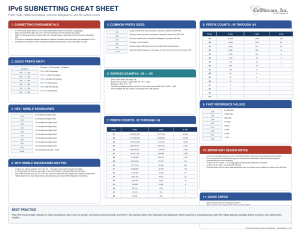
This updated IPv6 Subnetting Cheat Sheet is designed as a quick-reference guide for students, technic
ians, instructors, and network engineers who need to work with IPv6 prefix lengths without stopping to recalculate everything
from scratch. It brings together the most useful subnetting relationships in one place, including common /48, /56, /60, and /64 allocations, nibble boundaries, subnet counts, and the basic formulas used to divide larger IPv6 prefixes.
The sheet is especially useful because IPv6 subnetting is less about conserving individual addresses and more about understanding prefix structure, hierarchy, and clean allocation boundaries. Instead of memorizing large numbers, you can quickly see that a /56 contains 256 /64s, a /60 contains 16 /64s, and a /48 contains 65,536 /64s.
How to use the cheat sheet: start with the prefix you have been assigned, then decide what new prefix size you want to create. Use the quick formula—2^(new prefix - old prefix)—to determine how many subnets that split will produce. If your prefixes fall on 4-bit boundaries such as /48, /52, /56, /60, or /64, use the nibble-boundary section to work directly in hexadecimal.
Next, use the prefix-count tables to verify your results or quickly answer qu
estions such as, “How many /64s are inside a /52?” or “How many /60s can I create from a /56?” The worked example shows how those calculations translate into actual IPv6 prefixes, which makes the sheet useful not only as a reference but also as a learning tool.
Download it, print it, and keep it nearby for classroom instruction, certification study, lab work, IPv6 address planning, or troubleshooting. It is intended to make IPv6 subnetting faster, more visual, and easier to apply without having to rebuild the math every time.
Did you find this useful? Would you change or modify this file in any way? If you would like to help support the continued development of independent networking, broadband, Wi-Fi, VoIP, and packet analysis content, please consider joining our Patreon community where you will gain access to exclusive technical resources, downloadable labs and PCAPs, bonus course content, troubleshooting guides, and additional member-only material. You can also leave comments at our Discord server. You can also support our work by simply buying us a coffee — every contribution helps us continue creating practical, real-world network science education for professionals and enthusiasts alike.