

IP Multicast, IGMP, PIM, RTP/RTCP, and Streaming/IPTV Architecture
1-Day Instructor-Led Class
Available in either Web-Based Delivery or On-Site Delivery
Minimum 10 students – Maximum 40 students
Course Description
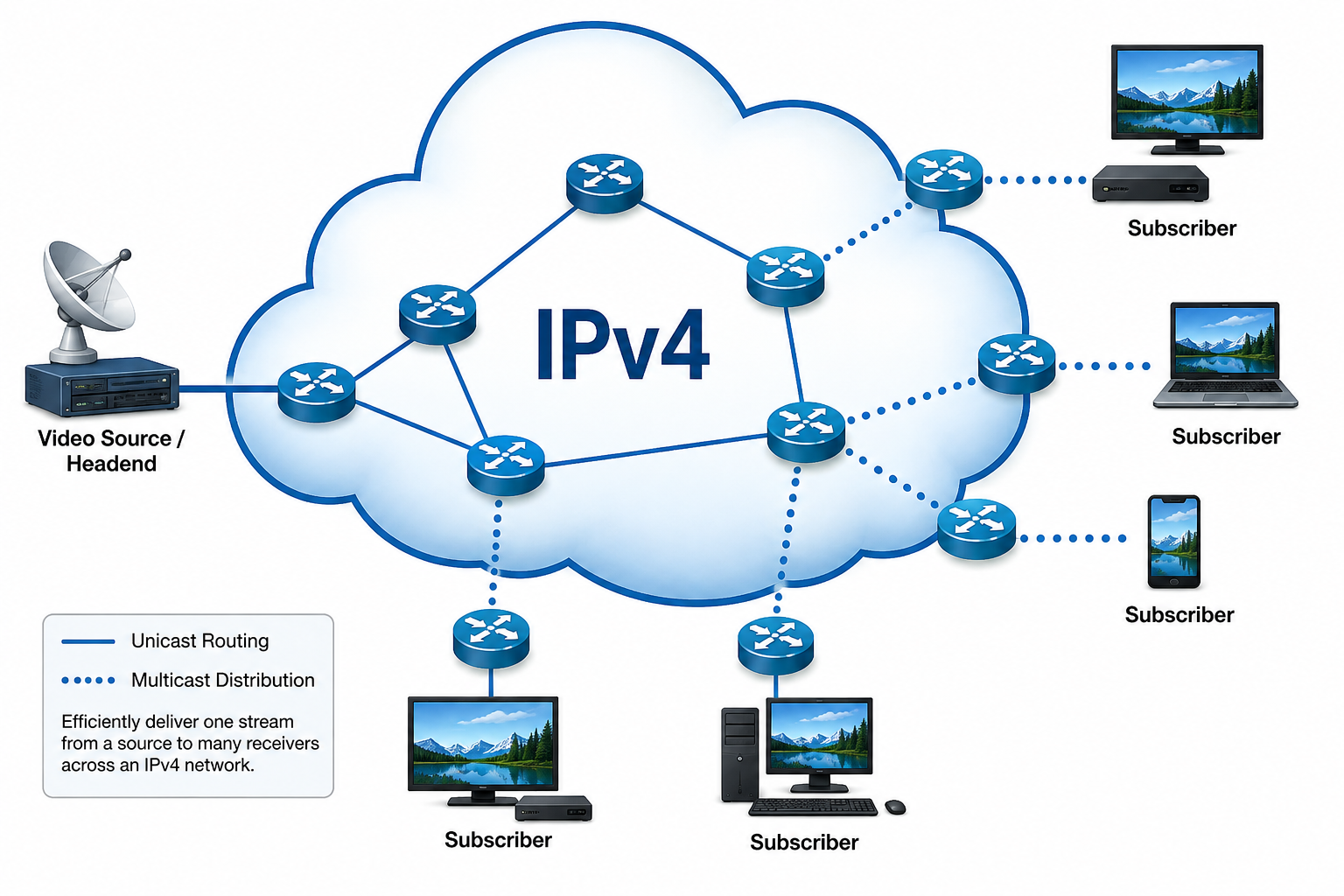
IP multicast provides an efficient method for delivering the same traffic from a source to multiple receivers without requiring a separate copy of the traffic for every destination.
CSI-SP-004 – IP Multicasting and IPTV is a focused one-day course designed to give technical, engineering, operations, and product personnel a practical understanding of the technologies used to deliver multicast-based video and other real-time services across IP networks.
The course begins with fundamental multicast concepts, addressing, multicast distribution trees, Reverse Path Forwarding, TTL, and administrative boundaries. Students then examine multicast routing using IGMP and PIM, followed by RTP and RTCP for real-time media delivery.
The final section connects these technologies to IPTV, examining the complete service path from the video source and headend through encoding, the core and distribution network, access network, and end-user equipment.
The goal is to help students understand how the individual protocols and network components work together to deliver multicast video services.
Why IP Multicast Matters
Sending the same high-bandwidth content individually to large numbers of receivers can consume significant network resources.
IP multicast addresses this problem by allowing the network to replicate traffic only where required.
Understanding multicast therefore requires more than knowing a multicast address. Network professionals need to understand:
- How receivers join multicast groups.
- How multicast traffic is forwarded.
- How multicast distribution trees are created.
- How Reverse Path Forwarding helps control forwarding.
- How IGMP communicates receiver interest.
- How PIM creates multicast routing paths.
- How real-time media can be transported using RTP and monitored using RTCP.
These concepts are essential to understanding multicast-based IPTV and other one-to-many IP services.
Course Objectives
Upon completion of this course, students will be able to:
- Explain the fundamental purpose of IP multicast.
- Describe the differences between unicast and multicast delivery.
- Understand Layer 2 multicast addressing.
- Explain multicast distribution-tree concepts.
- Describe Reverse Path Forwarding.
- Understand the roles of TTL and administrative boundaries.
- Explain how IGMP supports multicast group membership.
- Describe the fundamental operation of PIM Dense Mode.
- Describe the fundamental operation of PIM Sparse Mode.
- Understand basic multicast routing design.
- Explain the roles of RTP and RTCP in real-time media delivery.
- Describe the major functional components of an IPTV architecture.
- Explain the path from source video and encoding through the core, distribution, access network, and end-user equipment.
- Relate IP multicast technologies to practical video-service delivery.
The emphasis throughout the course is on connecting multicast protocols to the complete service-delivery architecture.
Audience
This course is designed for personnel who need to understand IP multicast and IPTV technologies without requiring an advanced multicast engineering background.
Ideal participants include:
- Service Provider Engineers and Technicians
- Broadband Engineers and Technicians
- Network Operations personnel
- Network Design Engineers
- Video and IPTV Operations personnel
- Product Managers
- Technical Marketing personnel
- Technical Sales Engineers
- Network Managers
- Systems and Test Engineers
- Technical Support personnel
The course is particularly useful for anyone who needs to evaluate, support, discuss, design around, or troubleshoot multicast-based network services.
Course Prerequisites
Students should have a basic understanding of Ethernet, IP networking, IPv4 addressing, and routing concepts.
Previous multicast or IPTV experience is not required.
The course is designed to build the necessary multicast knowledge from the fundamentals upward.
Course Outline:
- Section 1: Multicasting Concepts for Video and Audio
- IP Multicast Overview
- Addressing – Layer 2 MAC Multicast
- References
- Multicast Tree Models
- Reverse Path Forwarding
- Time to Live
- Administrative Boundaries
- Section 2: Multicast Routing – IGMP & PIM
- IGMP Protocol Details / Operational Model
- PIMv2 Dense Mode Protocol Details / Operational Model
- PIMv2 Sparse Mode Protocol Details / Operational Model
- Core Multicast Routing Design
- Pulling It All Together
- Section 3: RTP and RTCP
- Real Time Control Protocol
- Real Time Protocol
- Section 4: IPTV
- Operational Overview
- Engineering Functional Operations
- Definition and Protocol Stack
- Source Video – Head End
- Encoding and Compressing Source
- Core and Distribution
- Access Network
- End User Components
- Course Summary
- Evaluation
Why Take This Course?
IP multicast combines several technologies that can initially seem disconnected:
- Multicast addressing.
- IGMP.
- PIM.
- RTP and RTCP.
- Video encoding.
- Core and access networks.
- Subscriber equipment.
CSI-SP-004 connects those technologies into one understandable service architecture.
Students leave the course better prepared to understand multicast network designs, discuss IPTV systems with vendors and engineering teams, evaluate technical solutions, and troubleshoot the technologies involved in multicast-based service delivery.
Related Training
Students who want to continue developing their multicast and service-provider networking skills may progress into CellStream training covering:
- Advanced Layer 3 Routing
- OSPF
- BGP
- IPv4 networking
- IPv6
- MPLS
- Wireshark and Packet Analysis
- Voice over IP
- Network Troubleshooting
Course Availability:
Contact us for schedule dates and times via our contact form or through the details provided on the page.
View the course calendar and browse for our schedule. It will show scheduled courses and available dates for scheduling.
Course Description, Content, Outline, and Instructional Design are Copyright ©CellStream, Inc.